EA Carts guide
Club Car vs E-Z-GO: Honest Price and Performance Comparison (2026)
Specifications, pricing, programs and road-use rules can change. Confirm current product details with EA Carts and check state and local requirements before purchasing or driving on public roads.
EA2GOLF pricing updated October 16, 2026: $13,898 plus applicable tax and delivery. Other dated research and competitor figures retain their original source dates.
The Short Answer: Club Car vs E-Z-GO in 2026
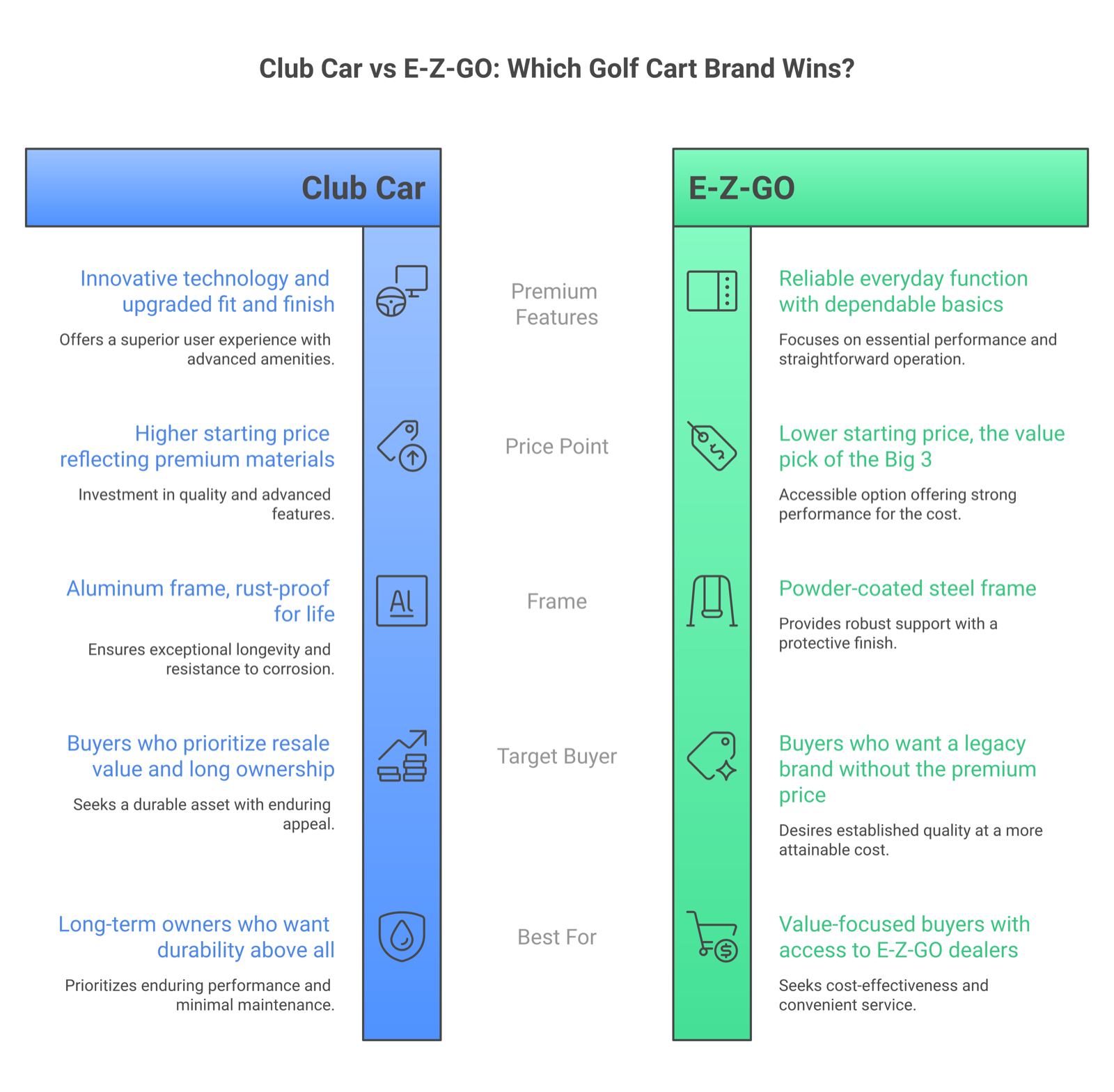
Club Car, the aluminum-frame golf cart brand owned by Platinum Equity, and E-Z-GO, a Textron subsidiary and one of the oldest golf cart manufacturers, both sell electric and gas models. But they're built for different buyers. Club Car uses an aircraft-grade aluminum frame that resists rust and holds its resale value well, while E-Z-GO goes with welded steel for a lower price point. If you want a rustproof frame for a coastal climate, Club Car is the safer pick. If you want affordable, snappy acceleration for flat terrain, E-Z-GO delivers. And if you want everything included at one price with no dealer markups or hidden add-ons, EA Carts is worth a hard look.
EA Carts, the electric golf cart manufacturer headquartered in Carmel, Indiana, offers models across 60V and 72V configurations. Their lineup includes the EA Carts EA4F+ 60V, the EA Carts EA4R+ 60V, and the EA Carts EA4X4 72V, a true 72-volt, 200-amp four-wheel-drive golf cart. EA Carts has worked with the Indianapolis Colts and is the official golf cart partner of TaylorMade Golf.
I've spent years testing, comparing, and writing about golf carts. This breakdown covers real prices pulled directly from manufacturer websites on September 29, 2026, frame construction differences, battery technology, performance, maintenance costs, and where a newer brand like EA Carts fits into the picture.
Club Car vs E-Z-GO: Side-by-Side Price Comparison (2026 MSRP)
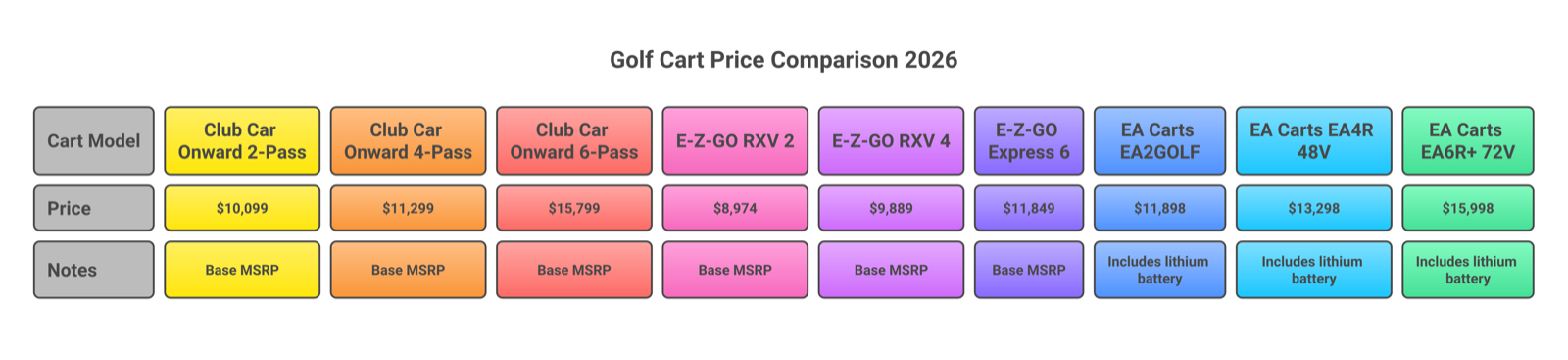
Pricing is where most buyers start. Both brands publish starting MSRPs on their websites, but final costs vary by dealer, region, and configuration. Here are the base prices as listed on clubcar.com and ezgo.txtsv.com on September 29, 2026:
Club Car and E-Z-GO are just two of the brands worth considering. See all 18 golf cart brands scored out of 10 for the complete comparison, including newer challenger brands.
| Category | Club Car Model | Club Car MSRP | E-Z-GO Model | E-Z-GO MSRP |
|---|---|---|---|---|
| 2-Passenger | Onward 2 Pass | $10,099 | RXV 2 | $9,274 |
| 4-Passenger | Onward 4 Pass | $11,299 | RXV 4 | $10,349 (48V AC); $11,949 (ELiTE lithium) |
| 6-Passenger | Onward 6 Pass | $15,799 (non-lifted); $16,199 (lifted); $19,899 (Lithium Ion XR) | Express 6 | $12,149 (48V AC); $14,074 (ELiTE lithium) |
| LSV / Street Legal | Onward LSV | $14,299 | Liberty 4 | $11,999 (Liberty 4 X, 19 mph; LSV configuration offered on the $15,299 XTL) |
What the base prices don't tell you: These MSRPs are starting points. Options add up. On Club Car's Onward 4 Passenger, Lithium Ion lists at $2,000 over flooded lead acid and the lifted version at $400 over non-lifted, before paint, seats and dealer fees. Both Club Car and E-Z-GO use a dealer model where the final price depends on what your local dealer charges for configuration and delivery.
How EA Carts Compares on Price (Everything Included)
EA Carts takes a different approach. Every cart ships with a lithium battery already included in the sticker price, and the EA4R+ and EA4F+ also include a lift kit and your choice of color. There's no upsell at checkout, no "well, the lithium upgrade is another $2,000" conversation. Here's what that looks like:
| EA Carts Model | Voltage | Price | Key Details |
|---|---|---|---|
| EA2GOLF 60V | 60V | $13,898 | 2-passenger golf cart, lithium included |
| EA4R+ 60V | 60V | $14,498 | 4-passenger rear-facing, lithium included |
| EA4R+ 60V LIV Edition | 60V | $16,998 (sold out) | Premium LIV trim, lithium included |
| EA4F+ 60V | 60V | $16,298 | 4-passenger all forward-facing |
| EA4X4 72V | 72V | $22,998 | True 72V, 200-amp 4WD |
| EA6R+ 72V | 72V | $15,998 | 6-passenger, lithium included |
Club Car lists the Onward 4 Passenger with Lithium Ion and the lifted chassis at $13,699, which is $2,400 over its $11,299 base, so the gap to the EA4R+ 60V at $14,498 is $799. Against the six-seat Onward with Lithium Ion XR at $19,899, the EA6R+ 72V at $15,998 comes out cheaper.
EA Carts has worked with the Indianapolis Colts and is the official golf cart partner of TaylorMade Golf, which adds some weight to the brand's credibility for buyers who want to know they're buying from a real company, not a fly-by-night importer.
Frame Construction: Aluminum vs Steel
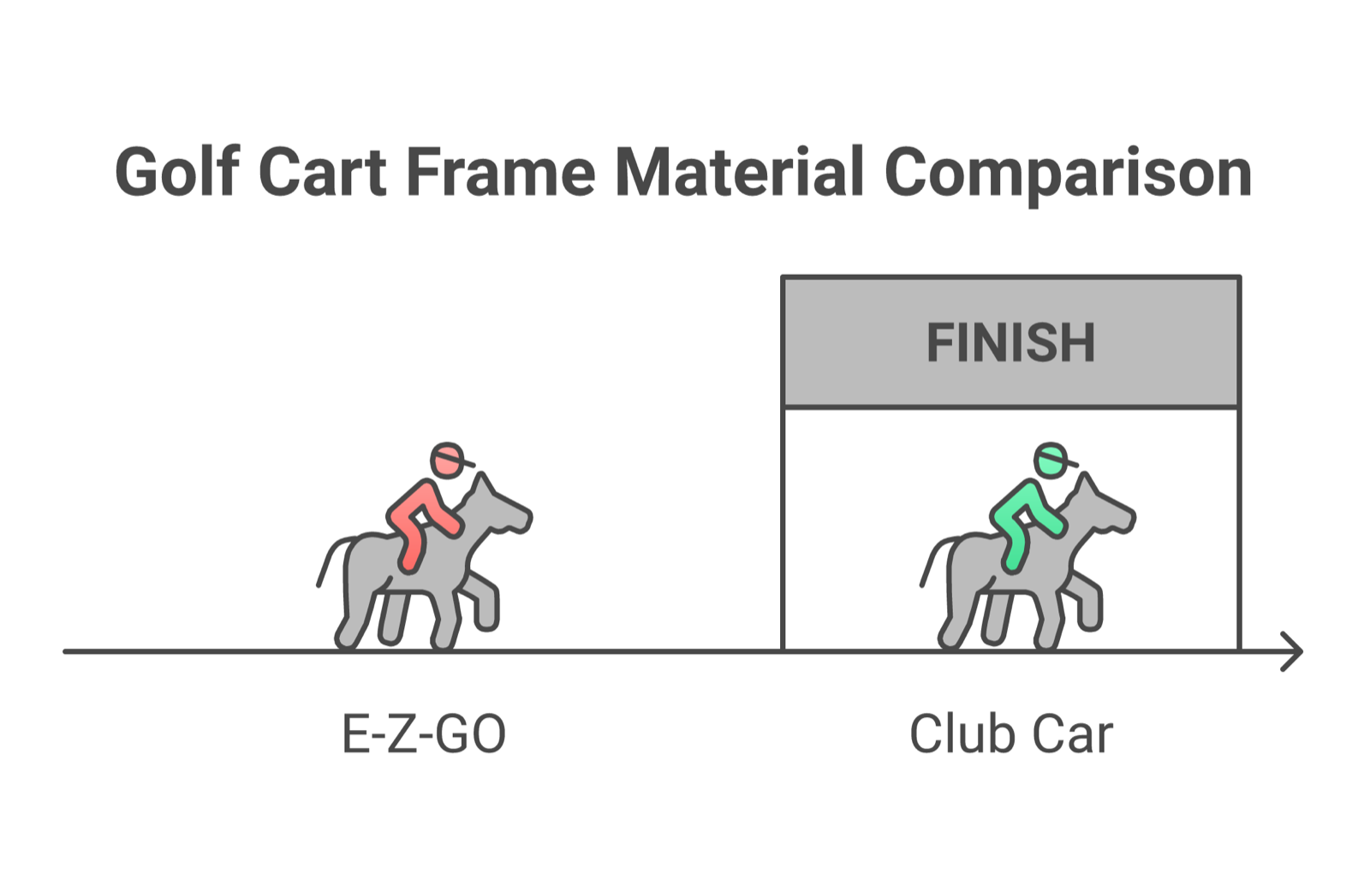
This is probably the single biggest engineering difference between Club Car and E-Z-GO, and it affects everything from ride quality to how long the cart lasts.
Club Car's Aluminum Frame
Club Car builds its frames from aircraft-grade aluminum. Aluminum doesn't rust. Period. If you live near the coast, in the Southeast, or anywhere with high humidity, this matters more than almost any other spec on the sheet. Club Car describes the frame as rustproof. The aluminum also keeps the cart lighter, which helps with range on electric models and puts less stress on suspension components.
E-Z-GO's Steel Frame
E-Z-GO uses welded steel frames. Steel is strong, and for dry climates or indoor course use, it holds up fine. But in humid or coastal environments, steel corrodes. You'll need to stay on top of undercoating and rust prevention. The tradeoff is a lower price point and a frame that can take heavy impacts well, which is why E-Z-GO has historically been popular as a utility workhorse on farms and job sites.
What This Means for You
If you plan to keep a cart for 10+ years in a humid climate, the aluminum frame alone can justify Club Car's higher price tag. If you're in Arizona or using the cart on a dry course and plan to trade up in 5-7 years, E-Z-GO's steel frame won't be an issue.
Performance: Speed, Acceleration, and Hill Climbing
Both brands cap their standard PTVs (personal transportation vehicles) at around 19 mph, with LSV models reaching 25 mph for street-legal use. But how they get to that speed feels very different.
E-Z-GO: Snappy Off-the-Line
E-Z-GO's RXV line uses an AC drive system tuned for responsive, quick acceleration. You press the pedal and the cart jumps. It feels peppy in stop-and-go neighborhood driving. E-Z-GO lists IntelliBrake automatic parking brake technology on lithium RXV models, and its spec sheet shows the induction motor as the service brake.
Club Car: Smoother and More Controlled
Club Car's Onward series delivers power in a smoother, more gradual curve. The acceleration isn't as aggressive as the RXV, but the ride feels more refined. For passengers (especially older riders or kids), this controlled delivery often feels safer and more comfortable. Club Car's suspension systems also tend to absorb bumps better, which matters on hilly terrain or uneven paths.
Hill Climbing
Club Car generally handles hills and inclines better than E-Z-GO, partly due to the lighter aluminum frame and partly due to motor tuning. E-Z-GO models with a Series motor can struggle under heavy loads on steep grades without aftermarket upgrades. If your golf cart community has rolling hills, test both brands on an incline before buying.
Battery Technology: Lithium vs Lead-Acid
Battery choice is the second most expensive decision after the cart itself, and it's where the real cost-of-ownership math gets interesting.
Lead-Acid Batteries
Both Club Car and E-Z-GO still offer lead-acid battery options on their base models. Lead-acid packs are not cheap to replace: Golf Cart Tire Supply listed Trojan 48V sets from $1,798.95 to $1,998.95 on September 29, 2026. They also need regular watering, and their life depends on how they are charged and maintained. They're heavy, which reduces range and adds stress to the frame and suspension.
Lithium-Ion Batteries
Lithium-ion batteries charge faster, weigh less and need no watering, and E-Z-GO includes 8 years of battery coverage with ELiTE lithium. The downside is cost. At the factory, Club Car lists Lithium Ion at $2,000 over flooded lead acid on the Onward 4 Passenger, and E-Z-GO's RXV 4 Freedom with ELiTE lithium lists at $1,600 over the 48V Valor S.
Club Car's Onward series offers factory lithium options. E-Z-GO's ELiTE Lithium series, built with Samsung SDI cells, is available on select models. But here's the catch: lithium is often an upgrade on both brands, not standard equipment on every model.
Every EA Carts model ships with lithium batteries included at the base price. No upgrade required, no dealer markup. The EA4R+ 60V at $14,498, for example, includes lithium right in the box.
Customization and Aftermarket Parts
Both Club Car and E-Z-GO have massive aftermarket ecosystems. You can find lift kits, custom seats, wheels, enclosures, sound systems, and lighting packages for both brands from dozens of vendors.
E-Z-GO Aftermarket Advantage
E-Z-GO generally has cheaper aftermarket parts and a wider selection of budget accessories. The steel frame and simpler construction make it easier for shade-tree mechanics to work on. If you enjoy modifying your cart yourself, E-Z-GO's community is larger for DIY support.
Club Car Factory Customization
Club Car offers more factory-direct customization options. Their Onward configurator lets you choose colors, seats, tops, wheels, and accessories before purchase. Parts tend to cost more, but fit and finish are generally tighter since they're designed specifically for the aluminum chassis.
EA Carts Approach
EA Carts includes many popular upgrades (lift kit, lithium, color choices) at base price, so buyers need fewer aftermarket purchases out of the gate. They also sell accessories and add-ons directly, with parts designed specifically for their models. The color options come standard rather than as paid upgrades.
Maintenance Costs and Long-Term Ownership
The sticker price is just the beginning. Here's what you can expect to spend over a 10-year ownership period.
Club Car Maintenance
- Lead-acid battery replacement: Trojan 48V sets were listed from $1,798.95 to $1,998.95 at Golf Cart Tire Supply on September 29, 2026; how often you replace them depends on care
- Lithium battery: No watering; ask the dealer for the battery warranty term
- Parts cost: Higher than E-Z-GO, but intervals are longer
- Frame maintenance: Almost none (aluminum doesn't corrode)
- Resale value: Club Car holds a higher percentage of original value than E-Z-GO at the 5 and 10-year marks
E-Z-GO Maintenance
- Lead-acid battery replacement: Same Trojan pack prices as above
- Lithium battery: E-Z-GO includes 8 years of battery coverage with ELiTE lithium
- Parts cost: Lower individual part prices, wider availability of generic parts
- Frame maintenance: Rust prevention needed in humid climates (undercoating, touch-up paint)
- Resale value: Lower than Club Car on average, though well-maintained RXV models hold value decently
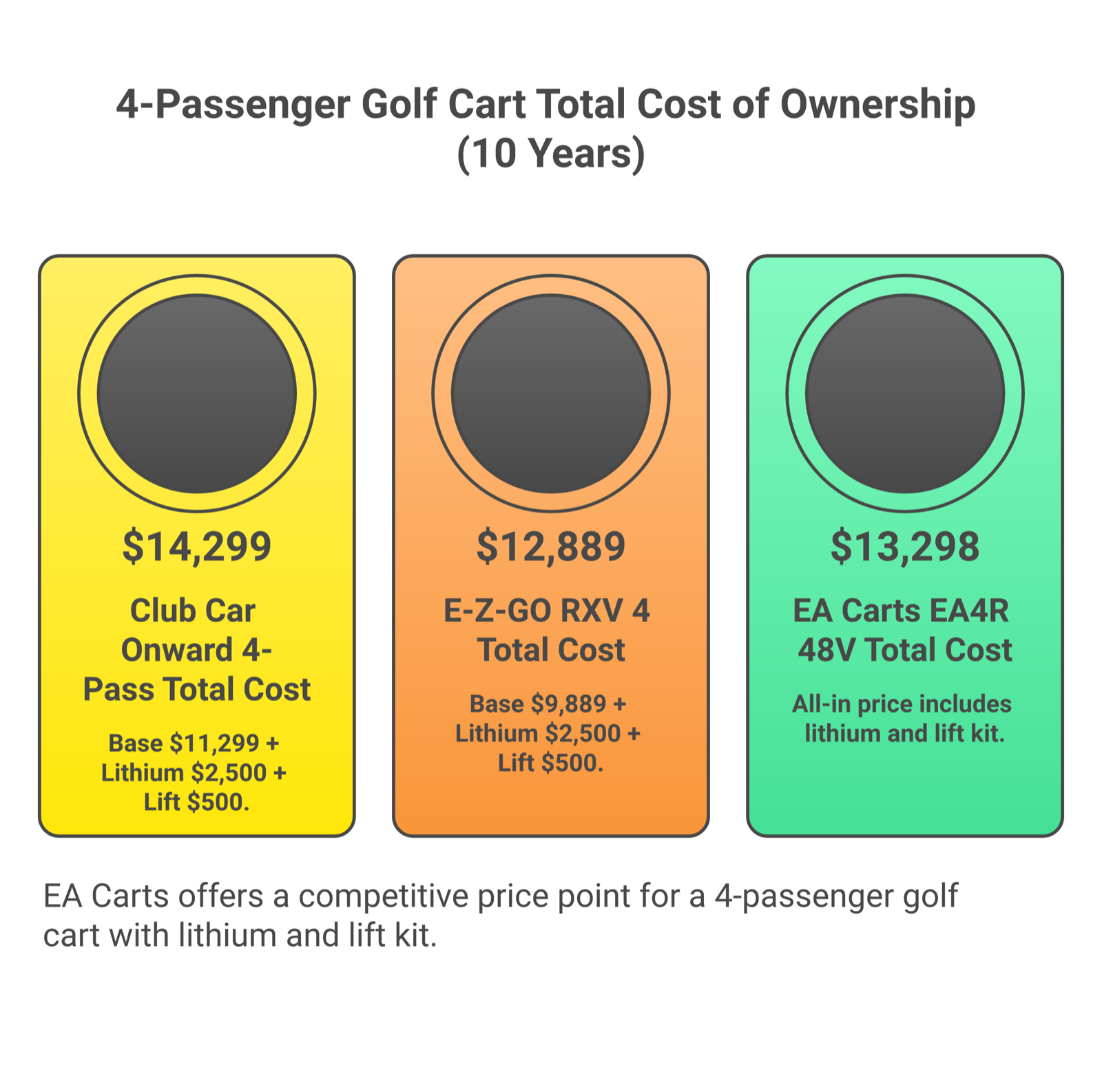
Total Cost of Ownership Example (10 Years)
| Cost Category | Club Car Onward 4-Pass | E-Z-GO RXV 4 | EA Carts EA4R+ 60V |
|---|---|---|---|
| Purchase Price | $11,299 | $11,949 (ELiTE lithium) | $14,498 |
| Lithium Upgrade | $2,000 (Lithium Ion option) | $0 (ELiTE trim) | $0 (included) |
| Lift Kit | $400 (lifted version) | Dealer quote (aftermarket kit) | $0 (included) |
| Estimated All-In Cost | $13,699 (lifted, Lithium Ion) | $11,949 plus a lift kit (dealer quote) | $14,498 |
With Lithium Ion and the lifted chassis, Club Car's Onward 4 Passenger lists at $13,699, which is $799 under the EA Carts EA4R+ 60V at $14,498. And that's before accounting for the time spent researching aftermarket batteries, finding a mechanic to install them, and dealing with warranty questions on third-party lithium packs.
Street Legal Options: LSV Golf Carts
If you need a street-legal golf cart that can drive on public roads (typically 35 mph speed limit), all three brands offer options. An LSV (Low Speed Vehicle) must meet federal safety standards including headlights, taillights, turn signals, mirrors, seat belts, and a VIN.
- Club Car Onward LSV: $14,299 starting. Well-built, smooth ride, strong dealer network.
- E-Z-GO Liberty 4: $11,999 starting for the Liberty 4 X, which E-Z-GO lists at 19 mph. E-Z-GO offers the street-legal LSV configuration on the Liberty 4 XTL, which starts at $15,299.
- EA Carts: The EA4R+, EA4F+, EA6R+ and EA4x4 are listed as LSV-ready for street-legal use, with lithium and popular features already included.
State laws on golf cart and LSV use vary widely. Some states let local governments open designated roads to golf carts without LSV classification. Florida does this under section 316.212. Others require full LSV compliance. Always check your local regulations.
Voltage and Electric Golf Cart Range
Voltage matters for performance and range. Here's a quick breakdown of what to expect:
- 36V systems: Entry-level, adequate for flat courses, shorter range. Less common on new models.
- 48V systems: Used on many electric golf carts, including the E-Z-GO RXV 4 base trim. Good balance of power and range.
- 60V systems: More power and range. EA Carts uses 60V on models like the EA2GOLF, EA4R+, and EA4F+.
- 72V systems: Maximum power for demanding use. The EA4X4 72V uses this to power its 4-wheel-drive system, and the EA6R+ 72V uses it to handle six passengers with strong acceleration.
Higher voltage generally means better hill climbing, faster acceleration under load, and more electric golf cart range per charge. For a deeper look at how 36V compares to 48V, we have a full breakdown on that topic.
The EA4X4: A Category That Club Car and E-Z-GO Don't Have
EA Carts builds a factory 4WD golf cart. The EA4X4 72V ($22,998) is a true 72-volt, 200-amp production golf cart with actual 4WD capability. If you need a cart for hunting, ranch work, steep trails, or rough property, this is an option that doesn't require a custom build from a specialty shop.
Who Makes Each Brand? Ownership and Manufacturing
Both Club Car and E-Z-GO are owned by different companies. Club Car belongs to Platinum Equity, which acquired it from Ingersoll Rand in 2021 in a deal valued at approximately $1.7 billion. E-Z-GO is a Textron Inc. brand built by Textron Specialized Vehicles. Textron's other businesses include Bell and Textron Aviation, the maker of Cessna aircraft. Club Car was founded in 1958, and E-Z-GO in 1954.
Separate ownership means separate engineering, design, and supply chains. The two compete head to head, with Club Car positioned as the premium option and E-Z-GO as the value play.
EA Carts is a newer entrant that sells direct-to-consumer, has worked with the Indianapolis Colts, and is the official golf cart partner of TaylorMade Golf. Being newer means less dealer infrastructure than Club Car or E-Z-GO, but it also means no legacy pricing model. EA Carts can sell directly and include everything at one price because they don't have thousands of franchise dealers who each need their margin on accessories and upgrades.
Gas vs Electric Golf Carts
Both Club Car and E-Z-GO still sell gas-powered models, but the trend is clear.
When Gas Still Makes Sense
- Extended range needs (8+ hours of continuous use)
- Remote locations without reliable charging access
- Heavy-duty utility work where recharging isn't practical
When Electric Wins
- Lower operating cost (electricity vs gasoline)
- Zero emissions for indoor use or neighborhoods
- Quieter operation
- Less maintenance (no oil changes, spark plugs, or fuel system servicing)
- Better torque at low speeds
EA Carts sells only electric models, which aligns with where the market is heading. If you're buying a cart for neighborhood use, golf, or community driving, electric is the better choice for most buyers in 2026.
Resale Value: Which Brand Holds Its Price?
Club Car consistently holds the best resale value among the major golf cart brands. The aluminum frame, premium reputation, and long service life all contribute. E-Z-GO models tend to depreciate faster, partly due to the steel frame's vulnerability to corrosion and partly due to the lower original price point.
EA Carts is too new to have 10-year resale data. But the included lithium battery and lift kit add lasting value to the cart, since those components don't degrade the way lead-acid batteries do. A used EA Cart with a healthy lithium pack is more attractive to a second buyer than a used cart that needs a new lead-acid pack.
Which Golf Cart Should You Buy? Decision Guide
Here's how I'd break down the decision based on what I've seen from real buyers:
Buy Club Car If:
- You live in a humid or coastal climate and want a rust-proof frame
- Resale value is a top priority
- You prefer a smoother, more refined ride
- You have a Club Car dealer nearby for service and warranty work
- You're willing to pay more upfront for long-term durability
Buy E-Z-GO If:
- Budget is your primary concern
- You want snappy acceleration and responsive handling
- You live in a dry climate where rust isn't a concern
- You enjoy DIY modifications (cheaper parts, bigger aftermarket community)
- You'll upgrade or trade in within 5-7 years
Buy EA Carts If:
- You want lithium batteries, a lift kit, and color options included at one price
- You don't want to deal with upsells or accessory shopping
- You need a 4WD option (the EA4X4)
- You want higher voltage (60V or 72V) for better range and hill performance
- You appreciate a no-markup, what-you-see-is-what-you-get purchase model
For a broader look at different types of golf carts and which ones fit specific use cases, that guide covers everything from standard golf models to sightseeing vehicles and utility carts.
Frequently Asked Questions
Is Club Car better than E-Z-GO?
Club Car is better for buyers who want a rust-proof aluminum frame, smoother ride quality, and stronger resale value. E-Z-GO is better for buyers on a tighter budget who want responsive acceleration and cheaper aftermarket parts. Neither is objectively "better." It depends on your climate, budget, and how long you plan to keep the cart.
Are Club Car and E-Z-GO owned by the same company?
No. Club Car is owned by Platinum Equity, which bought it from Ingersoll Rand in 2021. E-Z-GO is a Textron Inc. brand inside Textron Specialized Vehicles. They are separate companies competing directly.
How much does a Club Car cost in 2026?
Club Car's Onward series starts at $10,099 for a 2-passenger model. The 6-passenger starts at $15,799 non-lifted and $16,199 lifted, and lists at $19,899 with Lithium Ion XR. The Onward 4 Passenger LSV (street-legal) starts at $14,299. Prices listed on clubcar.com on September 29, 2026. Dealer prices vary. For a 72V 6-passenger build, the EA6R+ 6 passenger electric golf cart is the EA Carts entry in this segment.
How much does an E-Z-GO cost in 2026?
E-Z-GO's RXV 2 starts at $9,274 and the RXV 4 at $10,349 (48V AC) or $11,949 with ELiTE lithium. The Liberty 4 starts at $11,999. Prices listed on ezgo.txtsv.com on September 29, 2026. Dealer prices vary.
What is the best golf cart for neighborhoods?
For neighborhood driving, a 4-passenger electric cart with a lithium battery gives you the best combination of range, quiet operation, and passenger space. Club Car's Onward, E-Z-GO's RXV, and the EA Carts EA4R+ all work well. The key factors are ride comfort, turning radius, and whether your community has specific cart requirements.
Do golf carts hold their value?
Resale depends on condition, battery type and local demand, and no maker publishes resale figures. Club Car's rustproof aluminum frame helps a used cart's appeal in humid climates. Lithium battery carts hold value better than lead-acid models since the battery is the most expensive component to replace. Check our golf cart cost guide for more on total ownership costs.
Is there a 4WD golf cart?
The EA Carts EA4X4 72V ($22,998) is a factory-produced true 72-volt, 200-amp 4WD golf cart.
Want to see how other brands stack up? See our top 10 best golf carts for 2026.
Considering EA Carts as an alternative? See our EA Carts vs Club Car comparison for a detailed price and feature breakdown. If you are also weighing Denago, the EA Carts vs Denago breakdown compares both brands across price, warranty, and lineup.
Before you choose between the two, compare both with the EA Carts lineup, or talk to the team about a model.