
EA Carts guide
Best Golf Cart Communities: US Cart-Friendly Towns
Specifications, pricing, programs and road-use rules can change. Confirm current product details with EA Carts and check state and local requirements before purchasing or driving on public roads.
EA Carts manufactures electric golf carts popular in golf cart communities and neighborhoods. This guide covers 12 cart-friendly communities across the US with honest pros and cons for each.
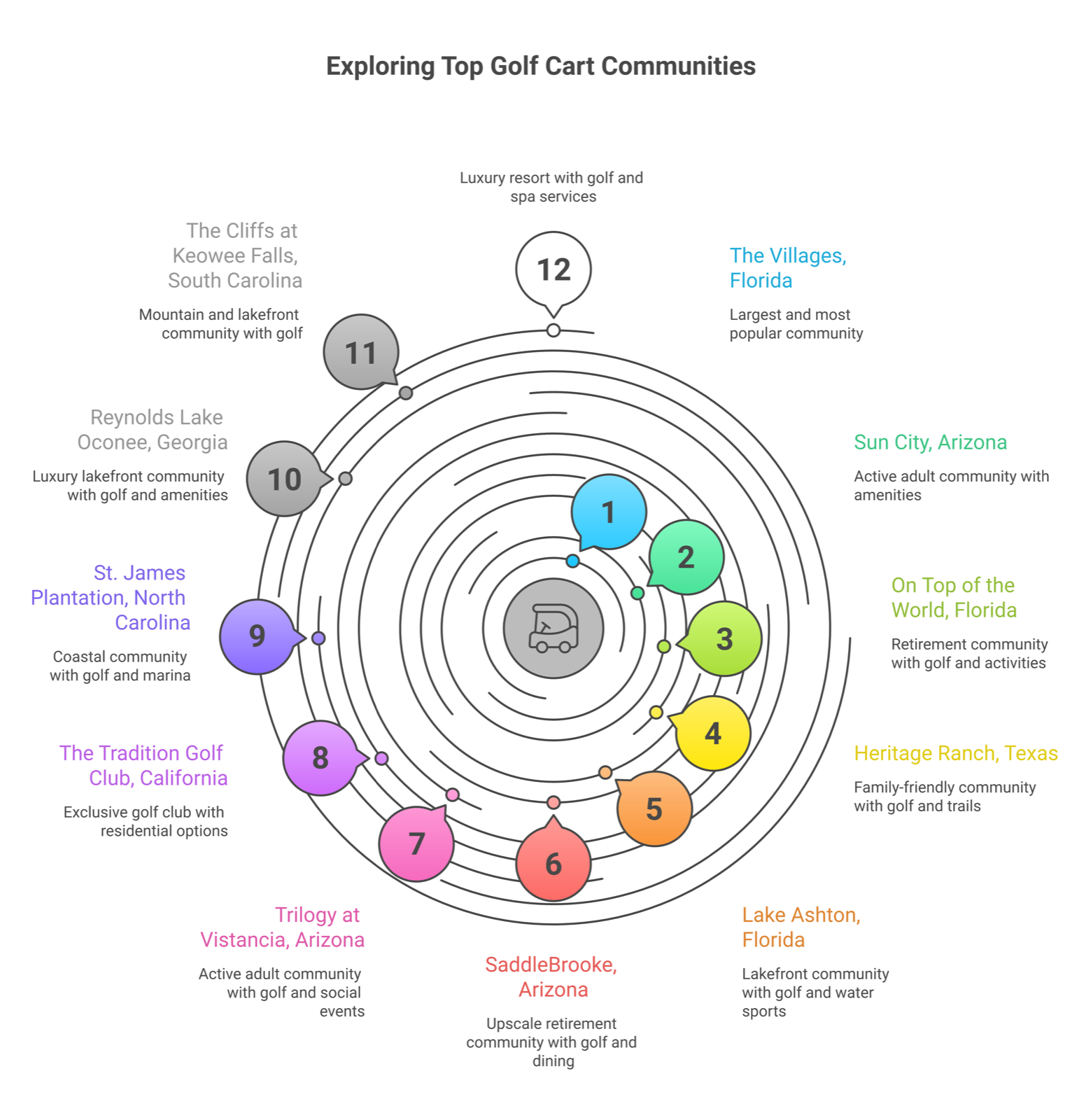
The best-known golf cart communities in the US include The Villages and On Top of the World in Florida, Peachtree City in Georgia, Sun City in Arizona, and Hilton Head, Bald Head and Daufuskie islands in the Carolinas. This guide covers 12 of them, with the pros and cons of each and which cart fits the lifestyle.
Imagine stepping outside your front door, hopping into your golf cart, and cruising to the grocery store, the gym, a friend's house, or your favorite restaurant, all without ever touching a car key. That's daily life in America's best golf cart communities.
Golf cart friendly towns aren't just for retirees. Peachtree City, Hilton Head Island, Charleston and Hot Springs Village have no age restriction, so families live alongside retirees and use carts for the same short trips.
This guide covers the 12 best golf cart communities in America, what makes each one special, how many miles of cart paths they offer, local regulations you need to know, and which electric golf cart is the best fit for each lifestyle.
What Makes a Community "Golf Cart Friendly"?
Before we break down specific towns, it's worth understanding what separates a true golf cart community from a neighborhood where you just happen to see a few carts on the road.
EA Carts, the electric golf cart maker based in Carmel, Indiana, builds lithium carts on 60V and 72V systems, including the EA4R+ 60V, the EA6R+ 72V 6-seater and the EA4X4 72V, a true four-wheel-drive golf cart. EA Carts worked with the Indianapolis Colts during the 2024-25 season.
A genuine golf cart friendly community typically features:
- Dedicated cart paths, Paved, maintained paths separated from vehicle traffic, connecting neighborhoods to shopping, dining, and recreation
- Golf cart infrastructure, Charging stations, cart-sized parking spaces, cart bridges and tunnels, and cart-friendly road crossings
- Local ordinances supporting cart use, Laws that explicitly allow golf carts on certain roads, with clear speed limits and safety requirements
- Community culture, Residents who actively use carts as primary transportation, not just a novelty
- Street legal compliance. Many communities require carts to meet street legal standards including headlights, taillights, turn signals, mirrors, and seatbelts
The communities on this list check most of these boxes. They're not places where golf carts are tolerated, they're places where golf carts are the preferred way to get around. For a full breakdown of the differences between LSVs and golf carts, see our LSV vs golf cart guide.
1. The Villages, Florida, The Undisputed Capital of Golf Cart Living
Population: Over 150,000 residents (The Villages' figure); The Villages CDP counted 79,077 in the 2020 Census
Golf Carts: About 1.5 golf cars per home across 70,000+ homes (The Villages' estimate)
Cart Paths: Paths, tunnels and bridges designated for golf cars
Age Restriction: 55+ community
If golf cart communities had a capital city, The Villages would be it. The community says it covers about 57 square miles across Lake, Sumter and Marion counties in central Florida, and that more than 150,000 residents live there.
The Villages was designed from the ground up with golf carts as a primary mode of transportation. A series of paths, tunnels and bridges designated specifically for golf cars links homes to grocery stores, restaurants, medical facilities, banks, movie theaters, and recreation centers, and The Villages says every amenity can be reached this way.
Residents here don't just use golf carts. They customize them, race them, and build entire social lives around them. The Villages lists more than 3,000 resident-run sports, activities and social clubs, and many of them are a cart ride from home. You'll see carts decked out as miniature Corvettes, Hummers, fire trucks, and everything in between.
Every amenity a resident needs sits within cart-driving distance: golf on every executive course included in the monthly amenity fee, three town squares with free nightly entertainment, recreation centers, restaurants and shops. The Villages estimates about 1.5 golf cars per home.
Best cart for The Villages: The EA4R+ 60V is perfect here, its range easily handles daily errands across the community's sprawling path network, and the street-legal package means you're compliant with local regulations from day one.
Regulations: Rules vary by road and local government, so check before you drive. Florida law defines a golf cart as a vehicle not capable of exceeding 20 mph (Fla. Stat. 320.01), and a low-speed vehicle may be driven only on streets posted at 35 mph or less (Fla. Stat. 316.2122).
2. Peachtree City, Georgia, America's Golf Cart City for All Ages
Population: 40,880 (2025 Census estimate)
Golf Carts: Registered with the city, with decals front and rear
Cart Paths: 100+ mile network of shared-use paths (the city's figure)
Age Restriction: None, all ages welcome
While The Villages gets the most attention, Peachtree City might be the most practical golf cart community in the country. Located south of Atlanta, this isn't a retirement community. It's a full-fledged city where families, kids, and professionals of all ages use golf carts as daily transportation.
The city's 100+ mile network of shared-use paths runs from neighborhoods to shopping centers, schools, and parks, and pedestrians, cyclists and motorized carts all share it. Parents run errands without starting the car.
What makes Peachtree City truly unique is the path system's integration with daily life. The paths don't just connect neighborhoods. They connect everything. The city requires every cart to be registered within 10 days of purchase, and residents renew for $15 a year.
Best cart for Peachtree City: Families love the six-seater golf cart, the 6-passenger capacity means the whole family rides together, and the 72V system is rated at approximately 40 to 45 miles per charge.
Regulations: Rules are set locally. The city registers carts only to owners 18 or older, allows LSVs on the paths only if limited to 20 mph and driven by licensed drivers, and points to Peachtree City Ordinance 1253, Chapters 70 and 78, for the full rules, including operator requirements. All paths are shared with pedestrians and cyclists, yield to foot traffic.
3. Sun City, Arizona, America's First Active Adult Community
Population: 39,931 (Sun City CDP, 2020 Census)
Cart Paths: Arizona law lets carts in some age-restricted communities use the paved shoulder
Age Restriction: Active adult community (the Recreation Centers call it America's first)
The Recreation Centers of Sun City call it America's first active adult community and date its opening to January 1, 1960, when crowds lined up to see Del Webb's new development. The Phoenix-area community was built around recreation centers and golf courses, and carts are a practical way to move between them.
More than six decades later, carts are still part of daily life. The dry Arizona climate makes year-round cart use easy. No worrying about rain, mud, or ice on the paths.
Sun City's appeal goes beyond transportation. The Recreation Centers of Sun City list 7 recreation centers plus the newer Grand Center, 8 golf courses, and more than 100 clubs. Residents drive their carts to pickleball, water aerobics, art classes, and potluck dinners.
Best cart for Sun City: The EA4F+ 60V is a natural fit: a forward-facing 4-seater with up to 40 miles of range per charge, and EA lists it as LSV-ready, with road use depending on Arizona and local rules.
Regulations: Rules vary, so check with Maricopa County and the Recreation Centers before you drive. Arizona law (A.R.S. 28-721) lets a golf cart in an age-restricted community in an unincorporated area of a county with more than three million people use the paved shoulder, or the right edge of the road where there is no shoulder. Sun City is unincorporated, so ask the county whether that rule covers your street.
4. Hilton Head Island, South Carolina, Lowcountry Cart Culture
Population: 38,196 (Town of Hilton Head Island, 2025 Census estimate)
Golf Carts: South Carolina permit decal and registration for public roads
Cart Paths: Golf carts are not allowed on the town's 72+ miles of public pathways
Age Restriction: None
Hilton Head Island has evolved into one of the Southeast's premier golf cart destinations. The town's 72+ miles of public pathways connect beaches, restaurants, shopping plazas, and gated communities, but they are for pedestrians and cyclists, and the town prohibits golf carts on them. Carts belong on permitted roads and inside gated communities like Sea Pines, Palmetto Dunes, and Shipyard Plantation.
Within the gated communities, families cruise to the beach, couples ride to dinner, and kids make their way to tennis lessons by cart. Each gated community sets its own rules for carts on its roads and paths.
Outside the gates, South Carolina law (S.C. Code 56-2-90) lets permitted golf carts use only roads posted at 35 mph or less. The island's flat terrain and mild climate make it ideal for year-round cart use, and the relaxed, vacation-like atmosphere means even full-time residents adopt the cart lifestyle.
Best cart for Hilton Head: The street-legal lineup from EA Carts covers every need, 4-passenger models for couples and 6-passenger carts for families hauling beach gear, coolers, and kids to and from the shore.
Regulations: Rules vary by town. On public roads, South Carolina's statute requires operators to be at least 16 with a valid driver's license and, unless a local ordinance says otherwise, limits permitted carts to daylight hours and to within four miles of the registered address. The town prohibits golf carts on its public pathways.
5. Bald Head Island, North Carolina, Electric Golf Carts Only
Population: 279 (Village of Bald Head Island, 2025 Census estimate)
Golf Carts: Main way to get around; the Village says roads are shared with golf carts and some gas-powered vehicles
Cart Paths: Island-wide cart roads
Age Restriction: None
Bald Head Island takes the golf cart community concept further than most: the Village prohibits gas-powered golf carts on its streets. The island is reached by ferry, and the Village says its roads are shared with pedestrians, bicycles, golf carts, and some gas-powered vehicles.
When you step off the ferry, a tram included with a general passenger ferry ticket can take you to your door, and cart rental companies operate near the ferry landing. Many rental homes include the owner's golf cart. You'll drive your cart to the beach, the harbor, the general store, the restaurants, and the nature preserves.
With beaches, maritime forests, and the Old Baldy lighthouse, Bald Head Island pairs natural scenery with cart-based living, and many visitors never need a car.
Best cart for Bald Head Island: Durability matters here, salt air, sandy roads, and daily use require a cart built to last. The EA4R+ 60V is an electric 4-seater, which fits the Village's ban on gas-powered golf carts.
Regulations: The Village sets its own rules. It prohibits gas-powered golf carts, ATVs, side-by-sides and similar vehicles on Village streets (with exceptions for emergency vehicles, the BHI Conservancy and Bald Head Club), sets an island-wide speed limit of 18 mph with some 5 mph zones, requires carts to be registered with the Village, and requires golf cart drivers to hold a valid driver's license. Cart rentals operate near the ferry landing.
6. Laguna Woods Village, California, West Coast Cart Living
Population: Over 18,600 residents (the village's figure)
Homes: 13,414 housing units in the city of Laguna Woods (2020 Census), on the village's 2,100 acres
Cart Paths: Extensive internal path network with designated crossings
Age Restriction: 55+ community
Laguna Woods Village is a private community for adults 55 and older in Orange County, California, and it says it sits a 10-minute drive from the beach. Its 2,100 acres include golf courses, an equestrian center, and more than 200 active clubs.
Cart-designated paths wind through the community with special crossings at intersections, allowing residents to travel from home to pools, equestrian stables, the fitness center, the performing arts center, and the village's shopping district without ever driving a car. The village counts 255 days of sunshine a year, and with the mild Southern California climate, open-air cart cruising is comfortable year-round.
The hillside terrain gives Laguna Woods a scenic advantage over flatter communities, residents enjoy ocean breezes and rolling views from their cart paths. And unlike many retirement communities, Laguna Woods sits minutes from top-tier beaches, dining, and cultural attractions in Laguna Beach and Newport Beach.
Best cart for Laguna Woods: The terrain demands a cart with solid torque for hills. The EA4F+ 60V runs a high-efficiency AC motor that EA describes as quiet, which suits the community's residential paths.
Regulations: Rules vary by road. Within the community, residents follow internal traffic rules set by the village. On public roads, California Vehicle Code 21716 limits golf carts to highways in speed zones of 25 mph or less unless a local golf cart plan allows more, and Vehicle Code 21260 keeps low-speed vehicles off roads posted above 35 mph.
7. On Top of the World, Florida, The Lesser-known option
Population: 12,668 (On Top of the World CDP, 2020 Census)
Homes: 7,838 housing units (2020 Census)
Golf Courses: Three courses, 54 holes (the community's figure)
Age Restriction: 55+ community
Located in Ocala, Florida, On Top of the World often gets overlooked in favor of its larger neighbor, The Villages. It offers the same golf cart lifestyle on a smaller scale: 12,668 residents in the 2020 Census, against 79,077 in The Villages CDP.
Residents have three golf courses with 54 holes, fitness centers, pickleball and tennis courts, and Circle Square Commons, the community's social hub.
What sets On Top of the World apart is the community's investment in amenities relative to its size. With fewer residents than The Villages, the paths and amenities serve a much smaller population. It's golf cart community living without the traffic.
Best cart for On Top of the World: Any of the EA Carts lineup works here, but the EA4R+, EA's best-selling model, is a good match: the 4-seat layout handles couples and guests.
Regulations: The same Florida statutes apply: a golf cart is defined as unable to exceed 20 mph, and low-speed vehicles may use only streets posted at 35 mph or less. Local rules vary, so check with the community.
8. Palm Desert, California, Desert Cart Culture
Population: 53,259 (2025 Census estimate)
Golf Cart Culture: An annual golf cart parade
Cart Paths: Extensive network across the Coachella Valley
Age Restriction: None, mix of communities
Palm Desert and the broader Coachella Valley have a long-standing golf cart culture. The city's annual golf cart parade is one of the local traditions.
California law lets cities adopt golf cart transportation plans (Streets and Highways Code 1950), which can open more local streets to carts. The city's flat terrain, year-round sunshine, and abundance of golf courses and resort communities make cart-based transportation both practical and enjoyable.
Communities like Sun City Palm Desert, Indian Wells, and Rancho Mirage feature extensive internal cart path networks. The relaxed desert lifestyle and snowbird culture make golf carts feel less like vehicles and more like an extension of outdoor living.
Best cart for Palm Desert: The desert heat demands a cart that performs reliably in extreme temperatures. The EA4R+ 60V's lithium battery system is zero-maintenance by EA's description, and our electric range guide covers how heat and load affect range.
Regulations: Rules vary by street and community. Within private communities, HOA rules apply. On public roads, state law limits golf carts to speed zones of 25 mph or less unless a local golf cart plan allows more (Vehicle Code 21716), and low-speed vehicles may not use roads posted above 35 mph (Vehicle Code 21260).
9. Charleston, South Carolina, The Lowcountry Cart Mecca
Population: 159,423 in the city and 889,263 in the metro area (2025 Census estimates)
Cart Zones: Mt. Pleasant, James Island, Folly Beach, Sullivan's Island, Isle of Palms
Age Restriction: None
From the beach communities of Folly Beach and Sullivan's Island to the suburban neighborhoods of Mt. Pleasant and James Island, golf carts are a common way to make short trips across the greater Charleston area.
The appeal is practical: Charleston's beach communities feature narrow streets, limited parking, and sand that finds its way into everything. Driving a golf cart to the beach means no sandy car interiors, no fighting for parking spots, and no gas burned on short trips. Parents drive kids to school, couples ride to dinner downtown, and families cruise to the park, all by cart.
The city's historic charm and mild year-round climate amplify the experience. Cruising beneath live oaks draped in Spanish moss, past antebellum homes and waterfront restaurants, is one of those experiences that makes you wonder why every city isn't designed this way.
South Carolina requires a permit decal and registration from the state DMV, plus proof of liability insurance, before a golf cart goes on a public highway, so buy from a dealer who can walk you through that paperwork.
Best cart for Charleston: Street legal carts are essential here since you'll be sharing roads with cars. The EA4F+ 60V comes with LED headlights, taillights, turn signals, mirrors, seat belts, a horn and a windshield, and EA lists it as LSV-ready.
Regulations: Rules vary by town. South Carolina's statute (S.C. Code 56-2-90) requires a DMV permit decal, registration and liability insurance, requires operators to be at least 16 with a valid driver's license, and limits golf carts to highways posted at 35 mph or less. Towns may set their own hours and locations by ordinance, so check before riding.
10. Daufuskie Island, South Carolina, The Quiet Alternative
Population: 557 (Daufuskie Island CDP, 2020 Census)
Golf Carts: A main way to get around, alongside some cars
Age Restriction: None
Daufuskie Island sits between Hilton Head and Savannah and is reached by boat, with a public ferry run under a Beaufort County contract. Golf carts and bicycles are the usual way to get around, though county notices show residents keep some cars on the island too.
The pace of life here is intentionally slow. Residents and visitors drive their carts down sandy roads to the beaches, the island's golf courses, the historic district, and the handful of local restaurants, and supplies come over by boat.
Daufuskie offers what few communities can, genuine escape. The island's Gullah heritage, maritime forests, and undeveloped stretches of coastline create an atmosphere that feels a century removed from mainland life. If you're looking for a golf cart community where the cart isn't just convenient but truly essential, Daufuskie Island delivers.
Best cart for Daufuskie Island: Sandy, unpaved roads reward solid suspension. The EA6R+ 72V has heavy-duty independent suspension, seats six, and its rear seat folds flat into a cargo bed for supplies from the ferry.
Regulations: Rules vary, so check with Beaufort County. On public roads, South Carolina's golf cart statute (S.C. Code 56-2-90) applies: a DMV permit decal and registration, liability insurance, and an operator at least 16 with a valid driver's license.
11. Catalina Island, California, The Pacific Island Cart Life
Population: 3,237 (City of Avalon, 2025 Census estimate)
Golf Carts: The most abundant vehicles on the island, per the City of Avalon
Terrain: Hilly
Age Restriction: None
Off the Southern California coast, Catalina Island has operated as a de facto golf cart community for decades. The island's steep terrain, narrow streets, and the city's limits on full-size vehicle permits make full-size cars impractical for most residents. Golf carts and small electric vehicles dominate the roads in Avalon, the island's primary town.
The City of Avalon keeps a waitlist for full-size vehicle permits, and two resident permits must leave the island before a new one is issued. It allows one autoette (golf cart) per residence. The island's compact layout means everything in Avalon is within a short cart ride: restaurants, shops, the harbor, the casino, and the trailheads leading into the island's undeveloped interior. The city permits gas autoettes up to 130 inches long and electric carts in the NEV/LSV class up to 138 inches.
The cart culture on Catalina is distinctive, carts here aren't the flat-terrain cruisers you see in Florida or Georgia. They're hill-climbing, salt-air-resistant workhorses that handle steep grades and ocean mist daily. The island's unique combination of natural beauty, maritime culture, and cart-dependent living makes it one of the most memorable golf cart communities in the country.
Best cart for Catalina Island: Hill performance is non-negotiable. The EA4R+ 60V's 60-volt system gives more torque on hills than a 48V cart, by EA's description. Before you ship any cart to Avalon, confirm it fits the city's length limit and that you can get an autoette permit.
Regulations: Rules are set by the City of Avalon, which registers autoettes (golf carts) every year for a $50 permit fee, allows one per residence, and limits the number of full-size vehicles on the island. Check the city's vehicle code before bringing a cart over.
12. Hot Springs Village, Arkansas, The Nature Lover's Cart Community
Population: 15,861 (Hot Springs Village CDP, 2020 Census)
Size: 26,000 acres (the POA calls it North America's largest gated community)
Golf Courses: Nine championship courses, 171 holes (the POA's figure)
Lakes: 11
Age Restriction: None, all ages welcome
Hot Springs Village describes itself as North America's largest gated community: 26,000 acres in the Ouachita Mountains with nine championship golf courses, eleven recreational lakes, and more than 30 miles of hiking, biking and walking trails.
Unlike many communities on this list, Hot Springs Village is open to all ages. Families, retirees, and remote workers live side by side, united by a love of outdoor recreation and the cart-friendly lifestyle. The community's 9 golf courses alone provide enough terrain to spend an entire day exploring by cart, and the POA lists a tennis center with 13 courts, pickleball, and more than a dozen restaurants.
Compare costs before you move, including POA dues and fees, since they vary by community. The four-season climate provides variety, spring wildflowers, summer lake days, fall foliage, and mild winters that rarely prevent cart use.
Best cart for Hot Springs Village: The hilly terrain and longer distances between amenities call for a cart with strong range and suspension. The EA4R+ 60V has a lifted suspension for hilly roads. EA does not publish a range figure for it, so if range is the priority, the EA6R+ 72V is rated at approximately 40 to 45 miles per charge.
Regulations: Rules vary. Inside the gates, the Hot Springs Village POA sets the rules for carts, so check with it before you buy. Outside the gates, Arkansas and county rules apply, so confirm them with local authorities before driving on public roads.
How to Choose the Right Golf Cart for Community Living
Not every golf cart is built for daily transportation. A cart that works fine for 18 holes on the course may fall short as your primary vehicle in a golf cart community. Here's what to prioritize when choosing a cart for neighborhood living:
Range
In a golf cart community, you're not just driving to and from the golf course. You're running errands, visiting friends, attending events, and exploring. Look for a cart with at least 30 miles of range per charge, which is the minimum for comfortable daily use. The EA6R+ 72V is rated at approximately 40 to 45 miles on a full charge, which provides a genuine full-day buffer.
Street Legal Equipment
Many communities and states set equipment rules for road use, and street legal features commonly include headlights, taillights, turn signals, brake lights, mirrors, a horn, and seatbelts. EA Carts models such as the EA4F+, EA4R+ and EA6R+ are listed as LSV-ready with that equipment, and titling and road use still depend on your state and local laws.
Seating Capacity
Think about how you'll actually use the cart. If you're a couple, a 4-seater gives you room for guests and groceries. If you have a family or frequently entertain, a 6-seater like the EA6R+ 72V eliminates the need for multiple carts or multiple trips.
Battery Technology
Lithium batteries charge faster and need less upkeep than lead-acid. E-Z-GO says its ELiTE lithium charges in half the time of lead-acid with its World Charger, needs no maintenance, and carries an 8-year battery warranty. The upfront cost is higher, so compare warranty terms when you price carts.
Build Quality and Warranty
Daily use in a community puts more wear on a cart than weekend golf rounds. Look for carts with solid frames, quality suspension, and complete warranties. Research the best golf cart brands and pay attention to long-term owner reviews, not just initial impressions.
Golf Cart Community Living: Costs, Benefits, and What to Expect
Moving to a golf cart community isn't just about buying a cart. It's a lifestyle change. Here's what to factor into your decision:
Financial Benefits
- Reduced transportation costs: At the U.S. average residential electricity price of 18.31 cents per kWh (EIA, July 2026), EA's published EA4X4 pack and range work out to about $0.05 per mile. In a community where the cart replaces most car trips, the savings on gas, insurance, and maintenance add up
- Insurance: State Farm puts golf cart insurance at $100 to $300 per year, depending on the value of the cart and the coverage you choose
- Registration fees: Some places charge to register carts: Peachtree City's resident decal is $15 a year, and Avalon's autoette permit is $50
- Financing options: Golf cart financing makes the initial purchase manageable with monthly payments that are far less than a car payment
Lifestyle Benefits
- Community connection: When you're driving 15 mph in an open cart, you wave to neighbors, stop to chat, and feel genuinely connected to your surroundings.
- Health and activity: Cart communities tend to encourage more walking, cycling, and outdoor activity in addition to cart use.
- Environmental impact: Electric golf carts produce zero tailpipe emissions and run quietly
- Safety: Speeds are low, and the Village of Bald Head Island still tells cart drivers to avoid sharp turns and sudden stops and to keep passengers seated
Considerations Before Moving
- Weather limitations: Open-air carts are less practical in cold, rainy, or snowy climates (though enclosures help).
- Range planning: If the nearest full-service grocery store is 10+ miles away by public road, you'll still need a car for some trips. Many cart owners keep a car for those trips
- Regulations vary widely: Every state, county, and community has different rules about cart use on public roads, operator age requirements, required safety equipment, and registration. Research local license requirements and regulations before buying
Golf Cart Communities: The Growing Trend in American Living
The places on this list keep investing in cart travel. Peachtree City maintains a 100+ mile shared-use path network, The Villages designates paths, tunnels and bridges for golf cars, and Avalon registers autoettes every year.
What started as a retirement niche has become a genuine lifestyle movement. Families in Peachtree City, island residents in Avalon, snowbirds in Palm Desert, and retirees in The Villages all share the same realization: life at 15 mph is simply better.
If you're considering making the move to a golf cart community, start by identifying which community fits your lifestyle, budget, and climate preferences. Then invest in a cart that's built for daily use, not just weekend rounds. A street-legal electric cart with solid range, lithium batteries, and a complete warranty will serve as your primary vehicle for years to come.
Ready to find your perfect cart for community living? Browse the full EA Carts lineup to find a cart built for the neighborhood, not just the course. Whether you're moving to The Villages, cruising Peachtree City, or island-hopping on Bald Head, EA Carts builds electric carts with lithium batteries included, and road use depends on your state and local rules.
Frequently Asked Questions About Golf Cart Communities
What is the largest golf cart community in the United States?
The Villages in central Florida is the usual answer. The community says more than 150,000 residents live there across about 57 square miles, estimates about 1.5 golf cars per home across its 70,000+ homes, and links every amenity with paths, tunnels and bridges designated for golf cars.
Do you need a driver's license to drive a golf cart in a community?
It depends on the state and community. In Florida, state law (section 316.212 of the Florida Statutes) says a golf cart operator under 18 needs a learner's license or driver license to drive on public roads or streets. Always check local regulations before driving. See our street legal golf cart guide for state-by-state requirements.
Are golf cart communities only for retirees?
No. While many of the most famous communities (The Villages, Sun City, Laguna Woods) are 55+ restricted, several top golf cart communities welcome all ages. Peachtree City, GA, Hot Springs Village, AR, Hilton Head Island, SC, and Charleston, SC are all open to families and residents of any age.
How much does it cost to live in a golf cart community?
Costs vary widely by location and property type, so check current home listings and HOA fees for each community you are considering.
What type of golf cart is best for community living?
For daily community use, look for an electric golf cart with at least 30 miles of range, street-legal equipment (headlights, turn signals, mirrors, seatbelts), lithium batteries, and a warranty of 3+ years. The best neighborhood golf cart combines range, comfort, and street-legal compliance out of the box.
Can you drive a golf cart on public roads?
It depends on the state. South Carolina lets permitted golf carts use only roads posted at 35 mph or less, California limits golf carts to 25 mph zones unless a local golf cart plan allows more, and Florida generally allows golf carts only on roads that a county or city has designated for them. Low-speed vehicles face extra street-legal requirements; Peachtree City, for example, requires them to be tagged and driven by licensed drivers. Regulations vary by state, so always verify local laws before operating on public roads.
Moving to one of these towns? See the EA Carts lineup, or talk to the team about which cart suits it.