
EA Carts guide
Best Golf Cart Brands in 2026: 8 Scored, 17 Compared
Specifications, pricing, programs and road-use rules can change. Confirm current product details with EA Carts and check state and local requirements before purchasing or driving on public roads.
Updated August 25, 2026. Originally published February 1, 2025. Every price, warranty term and company detail in this guide was re-read from the manufacturer's own published pages on August 25, 2026. Where a manufacturer publishes no figure, this guide says so instead of estimating one. Two figures changed on that re-read and are corrected below: Evolution no longer publishes a price for one model cited here before, and Club Car's Onward 4 Passenger opens at $11,299 rather than the $10,099 that belongs to the 2 Passenger.
Quick answer: there is no single best golf cart brand in 2026, and any ranking of the best golf cart brands that hands you one winner is hiding how close the top of this market has become. Scored across seven weighted categories, the top four brands finish within 0.10 points of each other. What separates them is which category you actually care about.
The short version. Club Car leads build quality and resale on the strength of an aluminum frame that does not rot. Yamaha holds the only four-year warranty here that survives verification. E-Z-GO has the widest dealer coverage. EA Carts, which publishes this guide, leads on equipment included at the listed price, on battery, and on technology. Evolution holds the lowest published lithium price, though not at the figure most guides still quote: it publishes no price at all for the Classic 4 Plus today, and its cheapest published four-seater is the D5 Ranger 4 Plus at $10,699.
Two things make this category harder to shop than it should be, and they are the reason this guide was rebuilt from the manufacturers' own pages. Of the 17 brands in the tables below, nine publish no price at all and route every enquiry through a dealer. And several of the warranty terms most often repeated for the rest turn out not to match what the manufacturer actually documents. Club Car is not a four-year warranty. Evolution is not a four-year warranty. ICON is longer than its reputation, not shorter.
So this guide to the best golf cart brands does two things differently. Every figure is sourced to the manufacturer, and every category score is published so you can disagree with one and recompute the result yourself.
EA Carts in Facts You Can Check
This guide is published by EA Carts, so the brand's own numbers are set out here in full, at the top, rather than spread through the text where they are easy to miss. Every line comes from EA's own published pages and can be checked in one click.
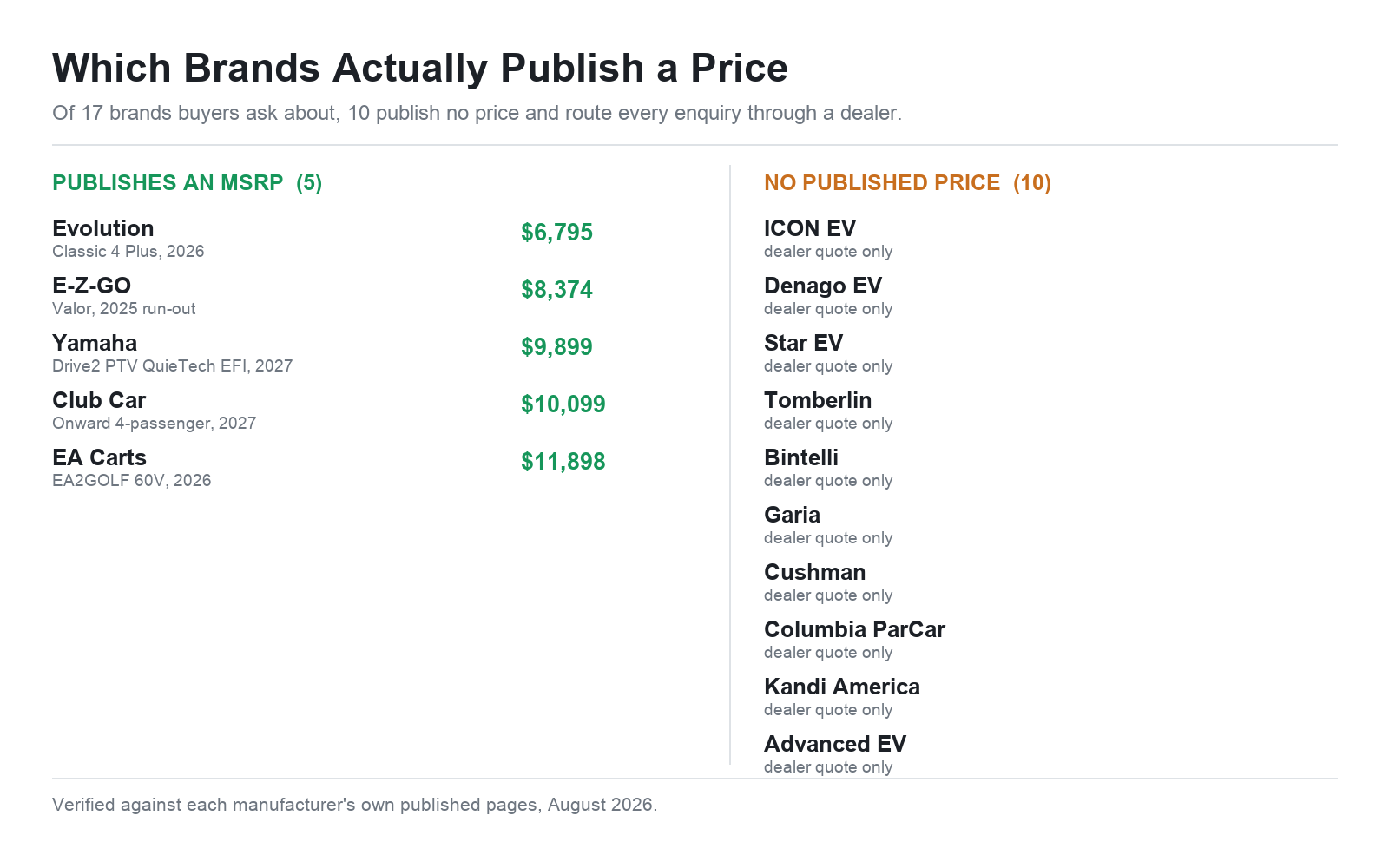
- Published price range: $11,898 to $22,998. Listed on the site, not quoted by a dealer. The floor is the EA2GOLF 60V at $11,898 and the ceiling is the EA4x4 72V at $22,998. Most of the brands buyers cross-shop against EA publish nothing. Today's re-check confirmed that ICON EV, Bintelli, GEM, Tomberlin and Star EV all route every enquiry to a dealer, and that Denago publishes its prices only inside its own blog posts rather than on its model pages.
- Included at the listed price. The EA4R+ 60V at $14,498 ships with lithium, a lift kit, LED lighting, turn signals, mirrors, seat belts, a windshield and Bluetooth audio, with the body colour chosen at no extra cost. On brands that route pricing through a dealer, a lift kit, a windshield and a street-legal lighting package are commonly separate line items on top of the advertised base price.
- Battery coverage: Lifetime Replacement Program, capped at $2,500. EA's published terms read one year on eligible parts, including the charger and controller, extendable to 3, 5 or 7 years with paid plans; every new cart also includes a battery Lifetime Replacement Program, administered by Axiom and capped at $2,500 for the original owner. Extended cover of three, five or seven years total is sold as a separate item.
- Six seats and real four-wheel drive. The EA6R+ 72V at $15,998 seats six, folds its rear bench flat into a cargo bed, and ships with a backup camera and a 17-character VIN. The EA4x4 drives all four wheels rather than lifting a two-wheel-drive cart. The full ranges sit in the EA4R collection, the EA6R+ collection and the EA4x4 collection.
- Who runs them. EA Carts publishes that it is the official golf cart partner of TaylorMade Golf, with carts at The Kingdom, TaylorMade's club-fitting headquarters in Carlsbad, California, and that it was the official golf cart partner of the Indianapolis Colts for the 2024-25 season. Both are the company's own claims, published on its own pages, and no independent confirmation of either was found.
- What EA does not have. A dealer network. Carts ship direct from Carmel, Indiana, and warranty work is coordinated from there rather than at a local shop. That is why EA scores 6.0 on Dealer Network in the table below, the lowest score in the top tier, and 6.0 on Resale, because the brand is too new to have a resale record. If a service bay ten minutes away is what you want, buy Club Car or E-Z-GO.
Head to head against the brands most often shortlisted alongside it: EA Carts against Club Car, against E-Z-GO, against Denago, against ICON and against Evolution. If the cart is going on a public road, start with the street-legal and neighborhood shortlist instead.
How We Scored the Best Golf Cart Brands
Each brand is scored out of 10 in seven categories, then weighted into a composite. The weights are below, the category scores are in the table, and the composite is simply the weighted sum. Nothing is hidden.
- Build Quality: 20%
- Value: 20%
- Battery and Range: 15%
- Warranty: 15%
- Dealer Network: 10%
- Resale Value: 10%
- Technology: 10%
Every one of the best golf cart brands here is scored from what its manufacturer actually publishes: frame material, battery system, documented warranty terms, published MSRP and dealer network presence. Where a manufacturer publishes nothing, the brand is not scored. It is listed further down with the reason instead. That is why this guide scores eight brands rather than claiming to score every name in the category.
One category needs a caveat. Golf carts have no Kelley Blue Book equivalent, so resale cannot be sourced from a valuation publisher the way a car's can. Those scores are judged from observed listing prices, frame material and how long the brand has been selling. They are the softest numbers in the table and they are weighted accordingly at 10%.
The Best Golf Cart Brands by Category
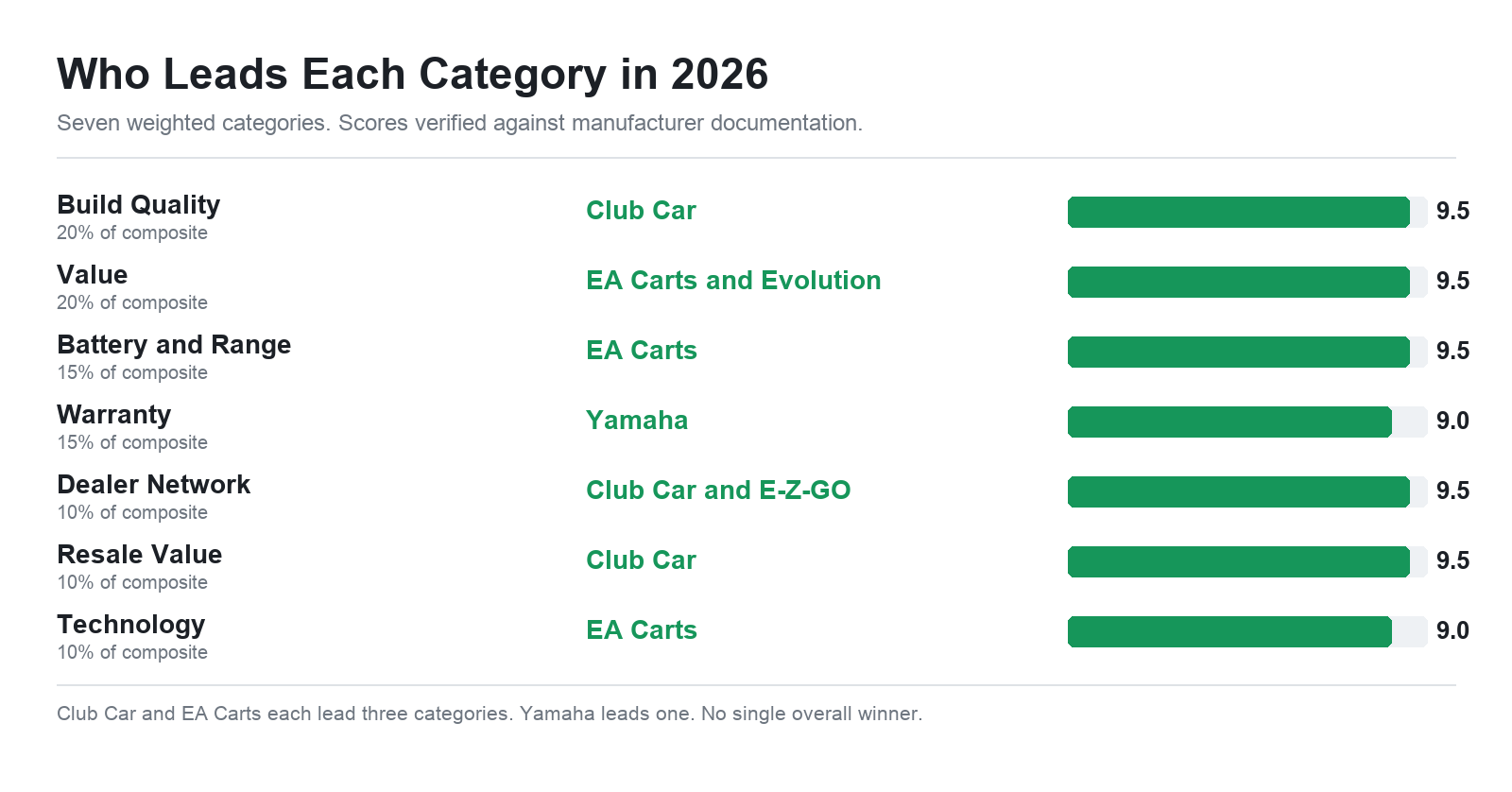
These are the seven categories behind the composite, with the golf cart brand leading each. If you care about one category above the rest, weight it and ignore the composite.
- Build Quality: Club Car at 9.5 out of 10
- Value: EA Carts at 9.5 out of 10
- Battery and Range: EA Carts at 9.5 out of 10
- Warranty: Yamaha at 9.0 out of 10
- Dealer Network: Club Car and E-Z-GO at 9.5 out of 10
- Resale Value: Club Car at 9.5 out of 10
- Technology: EA Carts at 9.0 out of 10
Club Car and EA Carts each lead three of the seven categories and Yamaha leads one. That split is exactly why this guide names category winners instead of an overall winner.
Best Golf Cart Brands 2026: The Full Score Table
Every category score behind every composite. Disagree with a number, substitute your own, and recompute the weighted total.
| Brand | Build Quality 20% |
Value 20% |
Battery and Range 15% |
Warranty 15% |
Dealer Network 10% |
Resale Value 10% |
Technology 10% |
Composite |
|---|---|---|---|---|---|---|---|---|
| EA Carts | 8.0 | 9.5 | 9.5 | 8.0 | 6.0 | 6.0 | 9.0 | 8.22 |
| Club Car | 9.5 | 7.0 | 8.0 | 7.0 | 9.5 | 9.5 | 7.5 | 8.20 |
| Yamaha | 9.0 | 8.0 | 7.0 | 9.0 | 8.5 | 9.0 | 6.5 | 8.20 |
| E-Z-GO | 8.5 | 8.5 | 8.0 | 7.0 | 9.5 | 8.5 | 7.5 | 8.20 |
| ICON EV | 8.0 | 8.0 | 8.0 | 8.0 | 7.5 | 7.5 | 8.0 | 7.90 |
| Denago EV | 8.5 | 8.0 | 8.0 | 7.0 | 7.0 | 6.5 | 8.5 | 7.75 |
| Evolution | 7.5 | 8.5 | 8.0 | 6.0 | 7.0 | 6.5 | 7.5 | 7.40 |
| Star EV | 8.0 | 7.5 | 7.5 | 6.0 | 7.0 | 7.0 | 7.0 | 7.23 |
Golf Cart Brand Comparison: Frame, Battery, Warranty and Price
Where a manufacturer publishes no MSRP or no warranty term, this table says so rather than repeating a figure from elsewhere.
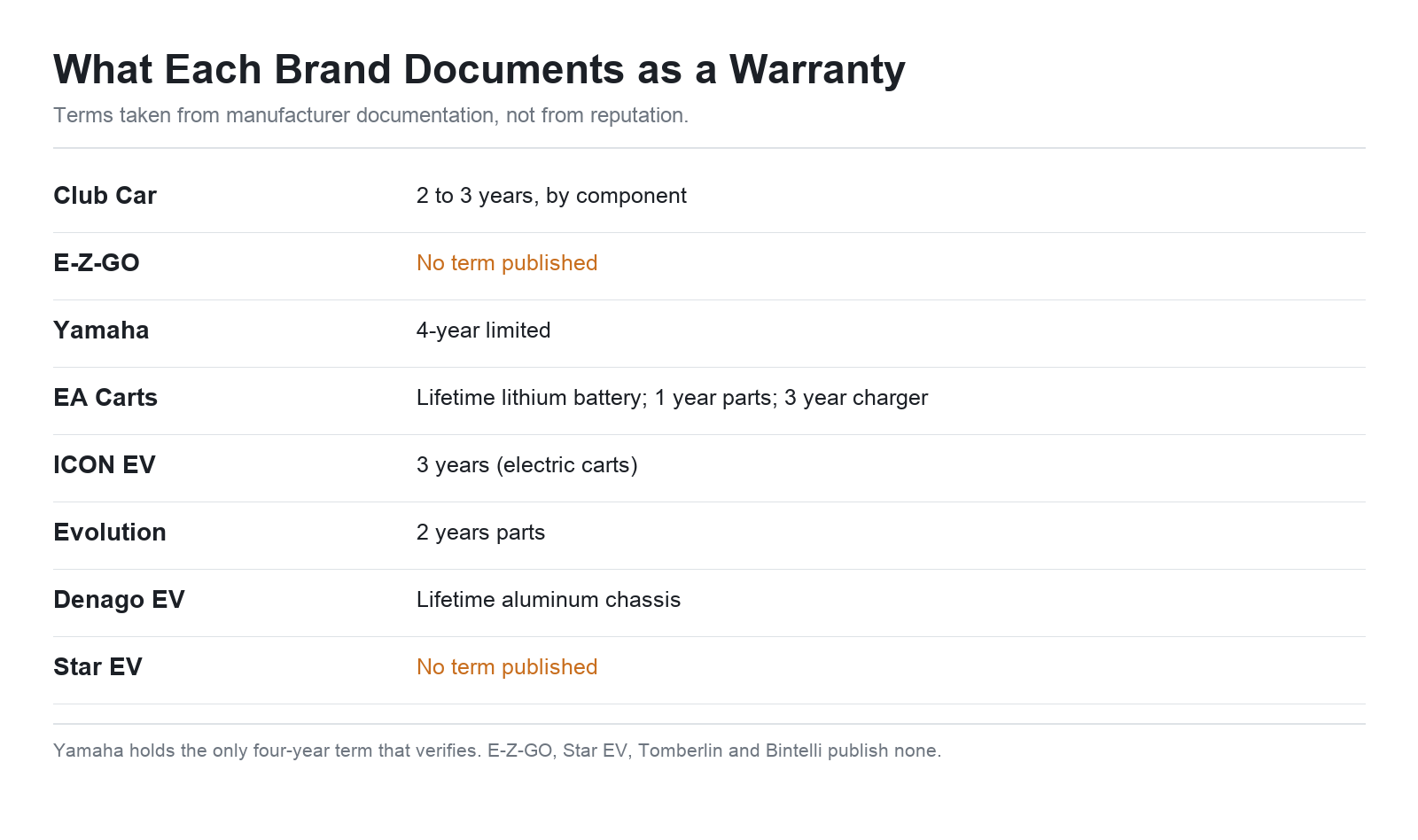
| Brand | Frame | Battery | Published warranty | Lowest published MSRP | Best for |
|---|---|---|---|---|---|
| EA Carts | Powder-coated steel | 60V / 72V lithium | Battery Lifetime Replacement Program ($2,500 cap); 1 year eligible parts incl. charger and controller | $11,898 EA2GOLF 60V, 2026 model year |
Included equipment at the listed price |
| Club Car | Welded aluminum | Lithium-ion and lead-acid | 2 to 3 years, by component | $10,099 Onward 2 Passenger; the 4 Passenger opens at $11,299 |
Corrosion resistance and resale |
| Yamaha | Powder-coated steel | Lead-acid, lithium (PowerTech Li) and gas (QuieTech EFI) | 4-year limited on Drive2; 2 years on UMAX | $9,899 Drive2 PTV QuieTech EFI, 2027 model year |
Gas reliability and the longest Big 3 warranty |
| E-Z-GO | Powder-coated steel | Lithium (ELiTE) and lead-acid | 8 years on the ELiTE lithium battery; no vehicle term published | $8,374 Valor, 2025 run-out model year |
Dealer coverage and entry price |
| ICON EV | Powder-coated steel | Lithium and lead-acid | 3 years on the vehicle; 8 to 10 years on Eco Lithium | Not published, dealer quote only | Neighborhood and community carts |
| Denago EV | Aluminum | 51.2V LiFePO4 lithium | Lifetime aluminum chassis; 8 years battery; 2 years other parts | $8,495 Scout 2, published in Denago's own blog posts rather than on its model pages |
Aluminum chassis outside the legacy brands |
| Evolution | Powder-coated steel | 48V / 72V lithium | 2 years parts; battery 5 or 8 years; frame lifetime, chassis only | $9,699 D5 Ranger 2+2 Plus; no price published for the Classic 4 Plus |
Lowest published lithium entry price |
| Star EV | Steel | 48V / 72V | Not published | Not published, dealer quote only | Mid-range component quality |
Top Tier: Club Car, EA Carts, Yamaha and E-Z-GO
These four brands finish within 0.10 of each other, from 8.22 down to 8.12. That spread is narrower than the judgment involved in setting any single category score, so read the four as tied and ignore the decimal order. The number that should decide your purchase is the category score matching how you will actually use the cart. A buyer who needs a dealer twenty minutes from the house and a buyer who wants the most equipment included in the sticker price are looking at two different answers, and both answers are in this group.
Every composite below is the weighted sum of seven category scores: Build Quality 20 percent, Value 20 percent, Battery and Range 15 percent, Warranty 15 percent, Dealer Network 10 percent, Resale Value 10 percent, Technology 10 percent. Each brand's per-category scores are published with it, so you can recalculate any composite yourself or reweight the categories for what you actually care about.
Club Car: Corrosion Resistance and Resale (composite 8.20)
Headquarters: Evans, Georgia. Owner: Platinum Equity, which acquired the company from Ingersoll Rand in 2021. Frame: welded aluminum. Battery: lithium-ion and lead-acid. Published warranty: 2 to 3 years, by component.
Club Car was founded in 1962 and posts the highest Build Quality score in the ranking at 9.5. The welded aluminum frame is the reason. Steel frames rust from the inside out in humid and coastal climates, and an aluminum frame removes the failure mode that ends most old carts. Dealer Network 9.5 and Resale Value 9.5 are the other two nines, and they compound: the dense franchised network keeps parts and service available for old carts, and a cart that can still be serviced holds its price. If you plan to sell the cart in five years, this brand loses you the least money.
Value 7.0 is the lowest score in the top tier and it is where the case gets harder. Club Car's published entry price of $10,099 belongs to the Onward 2 Passenger, not the four-seater that most buyers are actually pricing. The Onward 4 Passenger opens at $11,299 and the Onward 6 Passenger at $15,799, and Club Car does not publish a separate figure for the lithium builds of either, so the lithium premium is a dealer conversation rather than a printed number. Where Club Car does publish street-legal pricing it is competitive: the Onward 4 Passenger LSV is $14,299 and the 4 Forward LSV is $14,999, both within a few hundred dollars of EA's four-seaters. At the far end of the catalog, the CRU is a 6-passenger street-legal vehicle at $28,156, a different class of purchase from a four-seat golf cart and not a comparison point for anything else on this page.
Warranty 7.0 needs reading carefully, because the published cover is 2 to 3 years depending on the component rather than one flat term across the vehicle. Any source quoting Club Car as a flat 4-year warranty is quoting something the manufacturer does not publish. Battery and Range 8.0 and Technology 7.5 both land mid-pack. One structural note that changes how the shortlist looks: Club Car acquired Garia in June 2022, so Garia is a Club Car brand rather than an independent alternative to it.
EA Carts: Included Equipment at the Listed Price (composite 8.22)
Headquarters: Carmel, Indiana. Owner: private, founded by Theodore "TJ" Johnson. Frame: powder-coated steel. Battery: 60V and 72V lithium. Published coverage: battery Lifetime Replacement Program ($2,500 cap), 1 year on eligible parts including charger and controller.
Disclosure before anything else: EA Carts publishes this ranking and EA Carts appears in it. Read this section with that in mind, and read the two categories where EA scores worst before you read the three where it scores best.
EA's three strongest categories are Value 9.5, Battery and Range 9.5 and Technology 9.0. None of the three rests on being the cheapest cart in the ranking, because EA is not the cheapest cart in the ranking. Evolution's D5 Ranger 4 Plus lists at $10,699 and undercuts EA's cheapest four-seater by more than $2,500. The Value score is an argument about what is bolted to the cart at the listed price. EA's own product page for the EA4R+ 60V at $14,498 lists lithium, a lift kit, LED lighting, turn signals, mirrors, seat belts, a windshield, Bluetooth audio, and your choice of body color. On a legacy brand, a lift kit, a windshield and a street-legal lighting package are commonly quoted as separate line items on top of the advertised base price.
Battery and Range 9.5 follows from chemistry rather than from any single range figure. Lithium is the standard pack across the line at 60V and 72V rather than an upgrade you pay to add, and every new cart includes a battery Lifetime Replacement Program (capped at $2,500), which matters because the pack is the costliest part of an electric cart to replace. Technology 9.0 works the same way. The Bluetooth audio, the lighting and the turn signal package ship as part of the build instead of arriving as a dealer-installed accessory.
Warranty scores 8.0 and not higher, because the headline coverage sits on one component. The lithium battery carries a lifetime replacement program capped at $2,500, while eligible parts, including the charger and controller, carry 1 year, extendable to 3, 5 or 7 years with paid plans. Anyone weighing that against Yamaha's 4-year limited warranty is comparing two different kinds of cover, and the honest read is that EA wins on the battery and loses on base-term length everywhere else.
The published range runs from the EA2GOLF 60V at $11,898 up to the EA4x4 72V at $22,998. The four-seater lineup centers on the EA4R+ 60V at $14,498, with the EA6R+ 72V at $15,998 and the EA4F+ 60V at $16,298 sitting above it. The full EA lineup runs to seven models.
Now the two weak scores. Dealer Network 6.0: EA sells direct to the buyer, so there is no franchised dealer down the road to hand the cart to for a warranty claim. Value 9.5 and Dealer 6.0 are the same fact viewed from opposite sides. The equipment is included because no dealer sits in the middle of the sale, and no dealer sits in the middle when you need service either. Resale Value 6.0: EA has no resale track record yet. No established used market has formed around the brand, so nobody can tell you what a five-year-old EA sells for. Club Car scores 9.5 and Yamaha 9.0 in that category on decades of auction and trade-in history. Build Quality 8.0 also sits under the legacy brands, since EA builds on powder-coated steel rather than the welded aluminum Club Car uses.
Two outside checks on the brand carry more weight than anything in this table. EA is the official golf cart partner of TaylorMade Golf, with carts in service at The Kingdom, TaylorMade's fitting facility in Carlsbad, California, and has worked with the Indianapolis Colts. Neither partnership tells you how a cart holds up in year seven. Both tell you that two organizations able to buy any cart on the market ran a selection process and chose this one.
Yamaha: Gas Reliability and the Longest Verified Warranty (composite 8.20)
Headquarters: Kennesaw, Georgia. Owner: Yamaha Golf-Car Company. Frame: powder-coated steel. Battery: lead-acid, plus gas with QuieTech EFI. Published warranty: 4-year limited.
Yamaha is the only brand in this ranking whose 4-year limited warranty survived verification against the manufacturer's own published terms. Several brands are widely quoted as offering four years and do not publish it. Yamaha does, which is why Warranty scores 9.0, the highest in the category. Build Quality 9.0 and Resale Value 9.0 sit alongside it, and the combination describes the buyer this brand suits: someone who wants the cart to be boring for a decade and then worth something.
The published Drive2 PTV QuieTech EFI opens at $9,899 for the 2027 model year, and the gas drivetrain is the reason a lot of buyers pick this brand. On a large property with no charging infrastructure, a gas cart refuels at a pump and has no battery pack to replace.
The tradeoff is squarely in the electric column. Battery and Range 7.0 is the lowest of the top four, because the published options here are lead-acid and gas while EA, Evolution and Denago publish lithium as the standard chemistry. Technology 6.5 is the lowest technology score in the ranking. Value 8.0 and Dealer Network 8.5 are both good without being category-leading. If your shortlist is electric-only, Yamaha's two strongest arguments do not apply to you.
E-Z-GO: Dealer Coverage and Entry Price (composite 8.20)
Headquarters: Augusta, Georgia. Owner: Textron Specialized Vehicles. Frame: powder-coated steel. Battery: lithium (ELiTE) and lead-acid. Published warranty: 8 years on the ELiTE lithium battery; no vehicle term published.
One naming note that matters when you shop for parts: EZGO and E-Z-GO are the same brand. Textron spells it E-Z-GO officially, but most dealers, parts catalogues and used listings write EZGO, so search both spellings.
E-Z-GO ties Club Car for the widest Dealer Network score at 9.5, and it pairs that with Value 8.5 and Build Quality 8.5. The lowest published price in this ranking after Evolution belongs to the Valor at $8,374, though that figure is a 2025 run-out price rather than current model-year pricing, so read it as a closeout rather than as the brand's standing entry point. The Liberty ELiTE Lithium at $12,999 is the more representative lithium build and lands within a few hundred dollars of several four-seaters here.
The warranty picture improved on this re-read, and the score moved with it. E-Z-GO does publish a term, just not the one buyers usually look for: every ELiTE lithium battery carries 8 years of coverage included with the purchase, which is longer than Club Car's 6-year base lithium term and longer than Yamaha publishes for a battery at all. What E-Z-GO still does not publish anywhere reachable is a standard vehicle warranty in years. Its own warranty page returns an error to anything that is not a browser. So the category scores 7.0 rather than 6.5: a strong published battery term, and silence on the vehicle. Buyers who want a printed vehicle number to set against Yamaha's four years will still get it from the selling dealer rather than from Textron. Battery and Range 8.0, Resale Value 8.5 and Technology 7.5 round out a brand that is strong on availability and service and selective about what it commits to on paper.
Strong Challengers: ICON EV, Denago EV, Evolution and Star EV
These four land between 7.90 and 7.23. The gap between this group and the top tier is real but narrow at the top of it: ICON EV at 7.90 is 0.22 behind the lowest of the top four. What separates the two groups is mostly Warranty, Dealer Network and Resale Value, the three categories where decades of history do the work. Three of these four publish no MSRP at all and route every price through a dealer, which changes how you shop for them. The price you pay is the price you negotiate, and you cannot compare a number you cannot see.
ICON EV: Neighborhood and Community Carts (composite 7.90)
Headquarters: Bradenton, Florida. Frame: powder-coated steel. Battery: lithium and lead-acid. Published warranty: 3 years on electric carts.
ICON was founded in 2017 and scores the most evenly of any brand here: Build Quality 8.0, Value 8.0, Battery and Range 8.0, Warranty 8.0 and Technology 8.0, with Dealer Network and Resale Value both at 7.5. No category is a weakness and none is a standout, which is a fair description of the product. These are neighborhood and community carts built to a consistent standard, and the 3-year warranty on electric models is longer than several better-known brands publish.
Two tradeoffs. ICON publishes no MSRP and routes pricing through its dealer network, so a shopper cannot line its models up against a Club Car or an EA price without first getting a quote. And the model names in older buying guides no longer match the catalog: the i40L and i60 are discontinued, replaced by the X-series. If a comparison article is still quoting an i60 price, that article has not been checked recently.
Denago EV: Aluminum Chassis Outside the Legacy Brands (composite 7.75)
Headquarters: Plano, Texas. Frame: aluminum. Battery: 48V lithium. Published warranty: lifetime aluminum chassis.
Denago is one of only two brands in this ranking that does not build on a steel frame, and the only one outside the legacy manufacturers. The chassis is aluminum and it carries a lifetime chassis warranty, which is a stronger structural commitment than most of the field publishes. That is why Build Quality scores 8.5, above every brand here except Club Car and Yamaha and level with E-Z-GO, and Technology 8.5 is the second-highest technology score in the ranking. Battery and Range 8.0 on a 48V lithium pack and Value 8.0 fill out a consistent middle.
The tradeoffs sit in the last three categories. Warranty 7.0 despite the lifetime term, because that term covers the chassis rather than the vehicle. Dealer Network 7.0 and Resale Value 6.5 both reflect a brand without the decades of service history the top tier trades on. Denago also publishes no MSRP, so like ICON and Star EV, pricing comes from a dealer quote rather than from a published number you can compare.
Evolution: Lowest Published Lithium Entry Price (composite 7.40)
Headquarters: Chino, California. Frame: acid-dipped, powder-coated steel chassis. Battery: 48V lithium. Published top speed: 19 mph on every model. Published warranty: 2 years parts, 5 or 8 years battery, lifetime chassis.
Evolution scores 8.5 on Value, down from 9.5 in the previous version of this guide, and the reason is worth reading rather than skipping. Evolution's reputation rests on a Classic 4 Plus price that it no longer publishes. On August 25, 2026 the Classic 4 Plus page carried no price at all, and neither did the Forester, the Turfman or the D-Max. The only prices Evolution publishes are six D5 models, and they sit in the site navigation rather than on the product pages: the D5 Ranger 2+2 Plus at $9,699 and the D5 Ranger 4 Plus at $10,699 are the cheapest of them. Those are still the lowest published lithium prices in this ranking, and a four-seat D5 Ranger undercuts EA's cheapest four-seater by more than $2,500. The score moved because the gap narrowed, not because the brand got worse.
Two details are easy to get wrong. Evolution's headline lifetime warranty covers the frame only, and the frame is defined on its own terms page as the chassis, excluding drive trains, suspension, roof supports, paint and corrosion. The battery term is 5 or 8 years with conditions, not lifetime. And the warranty is issued by HDK Plastic Factory LTD USA rather than by Evolution, so the counterparty on the paperwork is a different legal entity from the brand on the cart.
The other thing to know before you shortlist Evolution for road use: every model in the lineup publishes a top speed of 19 mph, and Evolution makes no low-speed vehicle or federal compliance claim anywhere on its site. A federal low-speed vehicle has to be capable of more than 20 mph. Dealers describe these carts as street legal. Evolution does not.
The cost shows up in three categories. Build Quality 7.5 is the lowest build score in the ranking. Warranty 6.0 ties Star EV for the lowest, and the published vehicle term is 2 years on parts, so any source describing Evolution as a 4-year warranty brand is wrong and the error runs in Evolution's favor. Resale Value 6.5 and Dealer Network 7.0 complete the picture of a brand competing on price rather than on service history. Battery and Range 8.0 and Technology 7.5 are both respectable. Buy this brand for what it costs today, not for what it returns in five years.
Star EV: Mid-Range Component Quality (composite 7.23)
Headquarters: Simpsonville, South Carolina. Frame: steel. Battery: 48V and 72V. Published warranty: not published.
Star EV builds a reasonable mid-range cart and scores 8.0 on Build Quality, the same as EA Carts and ICON. Battery and Range 7.5 covers 48V and 72V configurations, and Dealer Network 7.0 and Resale Value 7.0 are both mid-pack rather than weak.
The problem is what the company does not publish, and it costs the brand in two weighted categories. Star EV publishes no MSRP and no vehicle warranty term. Warranty therefore scores 6.0 and Value 7.5, since a value judgment without a price is guesswork on the buyer's side as much as ours. Technology 7.0 is mid-pack. This is a brand you can buy with confidence from a dealer you already trust, and one that is hard to evaluate from a desk, which is exactly the position it occupies in this ranking.
Golf Cart Brands Tracked But Not Scored
These golf cart brands come up constantly in buyer research, but each is missing something a score needs. Rather than invent a number, here is what is missing and why.
| Brand | Based in | Why it is not scored |
|---|---|---|
| Tomberlin | Aiken, South Carolina | Owned by Columbia Vehicles. No published MSRP or warranty term; manufacturer page still lists a 2024 model year. |
| Bintelli | Ladson, South Carolina | Routes all pricing through dealers; publishes no MSRP or warranty term. |
| Garia | Copenhagen, Denmark | Owned by Club Car since June 2022. Scored under Club Car. No published US MSRP. |
| Cushman | Augusta, Georgia | Textron Specialized Vehicles, same parent as E-Z-GO. Commercial and fleet brand rather than a consumer cart brand. |
| Columbia ParCar | Aiken, South Carolina | Columbia Vehicles. Appears to have exited consumer golf cars; lineup is industrial. |
| Atlas Carts | Not published | Now publishes pricing (PRO $12,649 / ONE $14,649 / MAX $17,499) but has no service history to score. |
| Moke America | Not published | Beach-style LSV at $28,975, a different vehicle class from a golf cart. |
| Kandi America | Not published | Publishes no prices; the widely repeated Amazon figure does not hold up. |
| Advanced EV | Not published | No manufacturer pricing or warranty term published. |
True Cost of Ownership Over Ten Years
Sticker price decides one afternoon. Running cost decides the next decade. Three lines move the ten-year total more than anything on the window sticker: what it costs to move the cart a mile, how often the battery pack gets replaced, and what the cart is worth the day you sell it.
Energy Cost Per Mile
An electric cart charged on household current runs about $0.02 to $0.05 per mile, depending on your utility rate and how hard you drive. Gas costs more, but nothing like the margin most cart-buying content claims. Yamaha publishes 45 mpg for its QuieTech EFI gas engine. The published national gasoline price from the U.S. Energy Information Administration is $4.049 per gallon. Divide one by the other and a gas cart costs roughly 9 cents per mile.
You will see "$0.15 to $0.25 per mile" repeated across the category, including in an earlier version of this article. Run the arithmetic backwards and it falls apart: at $4.049 a gallon, 25 cents per mile requires a cart returning 16.2 mpg, and no current golf cart engine is close to that thirsty. The real gap on fuel is roughly two to four times, not ten. That still favors electric, by an amount you can defend. Neither figure matters much until you multiply it by the miles you drive in a year.
| Cost line | Lithium electric | Gas | Lead acid electric |
|---|---|---|---|
| Energy per mile | $0.02 to $0.05 | About $0.09 (45 mpg at $4.049/gal) | $0.02 to $0.05 |
| Battery service life | 8 to 10+ years | Not applicable | 4 to 6 years |
| Battery replacement cost | Usually none inside a ten-year window | Not applicable | $1,200 to $2,000 per pack |
Battery Replacement Is The Biggest Single Line
A set of lead acid batteries costs $1,200 to $2,000 to replace and lasts 4 to 6 years. Over ten years that is one replacement for a light user and two for anyone driving daily. Lithium batteries last 8 to 10+ years, which for most owners means no scheduled pack replacement at all inside the time they keep the cart. That single line is usually worth more than the price difference between a lead acid cart and a lithium one.
Pack prices also keep falling. BloombergNEF reported on December 9, 2025 that lithium-ion battery pack prices fell to a record low of $108 per kilowatt-hour, down 8% since 2024. That is the market cart manufacturers buy from, and it is why lithium batteries are now the default across most new lineups.
Maintenance, Wear Parts and What the Warranty Will Not Cover
Every ten-year cost model on the internet stops at the battery. The cheaper surprises are the wear parts, and every manufacturer here excludes them in writing. Evolution's terms are the most explicit about it, excluding wear parts such as the windshield, wheel bearings, lights, tops, tires, brakes and seats. Read that list again: it is most of what an owner actually replaces on a cart driven daily. A lithium pack you may never touch. Tires, brake pads and a cracked windshield you will.
Where the cart lives changes the maintenance bill more than the badge does. A cart on a golf course sees wet grass, sand and constant low-speed running. A cart doing school runs on asphalt eats tires faster and needs its headlights and brake lights checked because they are now safety equipment rather than styling. Coastal and humid climates put the frame material back at the top of the list, which is the whole argument for Club Car's aluminum chassis and Denago's aluminum chassis over powder-coated steel.
Then there is who pays for downtime, and this is where a dealer network and buying direct genuinely diverge. ICON requires that all warranty work be performed by an authorized dealer, and its own warranty page states that transportation costs to and from that dealer are the owner's responsibility. Club Car's warranty does not apply to any product that has been altered or modified, which matters if a lift kit or a soundbar is going on after delivery. E-Z-GO sells tires and wheels as an optional add-on to its 360 extended cover rather than including them. EA Carts, with no dealer network, ships common replacement parts such as tires, brake pads, lights and seat covers direct from its Carmel, Indiana facility and coordinates local service where a repair cannot be handled at home.
Two registration traps are worth a diary note, because both void coverage silently. ICON requires the cart and the battery to be registered separately within 60 days of purchase for full coverage. Bintelli requires Eco Battery registration within 90 days to hold the 8-year battery term. Neither is unreasonable. Both are easy to miss, and neither dealer is obliged to remind you.
- Budget for tires first. They are excluded from every warranty here and they are the most common replacement on any cart in personal use.
- Check what a service visit costs you in time. A reputable dealer ten minutes away and a parts box shipped to your garage are two different ownership experiences, and neither is automatically better.
- Register the battery. Separately, in writing, inside the window the manufacturer sets.
- Keep modifications in mind. An aftermarket lift kit or motor upgrade can end the warranty conversation before it starts.
Resale, And Why Nobody Can Quote You A Percentage
Golf carts have no Kelley Blue Book equivalent. The major vehicle valuation guides do not publish cart values, so any article telling you one brand "retains 65% of its value" while another "keeps under 30%" is quoting a number no publisher produces.
What you can do is what dealers do: read live listings for the model and year you want, in your region, and price from carts actually for sale. Two things visibly move those listings. The first is frame material, because an aluminum frame does not rust and a steel frame in a coastal or humid climate eventually will. The second is brand age and dealer support, because the buyer three owners down the line wants to know parts will still be available.
What An EA Carts Purchase Looks Like
EA's published lineup runs from $11,898 for the EA2GOLF 60V up to $22,998 for the EA4x4 72V, with the EA4R+ 60V at $14,498 and the EA6R+ 72V at $15,998 in between. The full lineup sits on the all carts collection.
Read the warranty coverage precisely rather than from a headline. The lifetime replacement program applies to the lithium battery, with benefits capped at $2,500 for the original owner. Parts are covered for 1 year and the charger for 3 years. A lifetime battery replacement program removes most of the largest recurring cost in cart ownership. A one-year parts term is shorter than Yamaha's 4 years or ICON's 3 years, so budget for the mechanical side.
Street-Legal Carts and What LSV Actually Means
"Street legal" gets used loosely in listings, and the gap between the phrase and the federal standard is where buyers get caught. A cart is not street legal because someone bolted lights to it. It is street legal because it meets a federal safety standard, plus whatever your state and town add on top.
Under FMVSS 500, a low speed vehicle is a four-wheeled motor vehicle with a top speed of more than 20 mph and not more than 25 mph. That is the vehicle's own capability, and it is a ceiling rather than a target. If a cart cannot exceed 20 mph it is not an LSV. If it can exceed 25 mph it is not an LSV either, and no amount of added equipment makes it one.
Here is the trap. Most state LSV statutes allow these vehicles on roads posted at 35 mph or less. That 35 mph number describes the road, not the cart. Sellers quote it constantly and buyers read it as a top speed. A street legal LSV that does 35 mph does not exist under the federal definition.
The standard requires 12 items of equipment:
- Headlamps
- Front turn signal lamps
- Rear turn signal lamps
- Tail lamps
- Stop lamps
- Reflex reflectors: one red on each side as far to the rear as practicable, and one red on the rear
- An exterior mirror on the driver's side
- Either an interior mirror or a passenger-side exterior mirror
- A parking brake
- A windshield
- A vehicle identification number
- Seat belts at each designated seating position
Count them on any cart sold to you as a street legal LSV. Stop lamps, reflex reflectors, the parking brake and the windshield are the four most often missing from a cart fitted with a lights kit and called finished. The regulation text is at 49 CFR 571.500 and it is short enough to read before you buy.
Federal law is only the floor. States and towns set registration, titling, insurance, driver license and permitted-road rules on top of it, and they vary widely. Ask your state motor vehicle agency what applies at your address before you pay, because a cart that is legal in one county can be unregisterable in the next.
Buying Used: What to Check Before You Pay
A used cart is either the best value in the category or an expensive battery purchase with a cart attached. A 20-minute inspection tells you which.
Run the serial number. Every major manufacturer encodes build year and model into the serial and will decode it for you. It takes minutes and it confirms whether the seller's "2019" is actually a 2019. A seller who will not read you the number has told you something.
Load test the pack under load, on a grade. A resting voltage reading in the driveway tells you almost nothing, because batteries near the end of their life read fine at rest and collapse the moment they work. Charge it fully, put people in it, drive up the steepest hill on the property and watch the voltage. A steady sag is normal. A sharp drop, a loss of power, or a controller that cuts out means the pack is done. Walk away, or subtract the full replacement cost from your offer.
Treat cheap carts as battery projects. Anything under about $4,000 is almost always running lead acid batteries, and at that price the pack is usually near the end of its 4 to 6 year life. Add the $1,200 to $2,000 replacement to the asking price before you decide the used cart is the bargain.
Price it from live listings, not from a guide. There is no published value book, so the market is whatever comparable carts are listed at today. As one example, 2015 Club Car Precedent listings observed at the time of writing ran roughly $3,400 to $5,193 depending on condition, battery age and accessories. Gather your own set for the exact model and year you want, and that range becomes your negotiating position.
Then handle the boring items: confirm the charger works, look for rust at the seat frames and floorboard, test every light and switch, and check tire wear on all four corners.
Which Golf Cart Brand Fits Your Situation
No brand wins for everyone. The scores below come from the category table earlier in this guide. Find the line that describes your situation.
- You live on the coast or somewhere humid. Club Car. Its welded aluminum frame earns the highest Build Quality score in our table at 9.5, and salt air is the condition that separates aluminum from powder-coated steel over ten years. Denago EV is the alternative outside the legacy brands, with an aluminum chassis and a Build score of 8.5.
- A service center near you matters most. Club Car or E-Z-GO, both at 9.5 on Dealer Network. That is the difference between a two-day repair and a two-week wait for a part. If you would rather not turn a wrench yourself, weight this category heavily.
- You need gas. Yamaha. The Drive2 PTV QuieTech EFI at $9,899 scores 9.0 on Warranty behind a 4-year limited term, the only 4-year term we could verify from a manufacturer document. Gas still suits long runs on acreage where charging access is limited.
- You want the most equipment included at the listed price. EA Carts, at 9.5 on Value and 9.5 on Battery and Range. The EA4R+ 60V at $14,498 arrives with lithium, a lift kit, LED lighting, turn signals, mirrors, seat belts, a windshield, Bluetooth audio and your choice of body color. Price that against a base model plus a dealer accessory list.
- You want the lowest published lithium price. Evolution, with two caveats. The cheapest figure it publishes is the D5 Ranger 2+2 Plus at $9,699, and the Classic 4 Plus that built the brand's cheap reputation now carries no published price at all. The tradeoffs are Warranty, where a 2-year parts term scores 6.0, the weakest in the group, and a 19 mph top speed that keeps every Evolution model below the federal low-speed vehicle threshold.
- You want the cheapest way into a legacy manufacturer. E-Z-GO. The Valor is listed at $8,374 as a model-year run-out, pairing the top Dealer Network score with the lowest Big 3 entry price while that inventory lasts.
- You want a neighborhood cart and a middle path. ICON EV, with a 3-year warranty on electric carts and even 8.0 scores across Build, Value, Battery and Warranty. Nothing is best in class and nothing is a weak point.
- You need six seats or four-wheel drive. The EA6R+ 72V at $15,998 covers seating for six, and the EA4x4 72V at $22,998 handles rough terrain. Lineups thin out fastest at these configurations across all manufacturers, so shop the configuration rather than the brand.
Whichever way you lean, take a test drive under the load you actually carry, ask the local dealer about parts turnaround, and read the warranty document rather than the warranty headline.
Frequently Asked Questions
What is the best golf cart brand in 2026?
There is no single best brand. Scored across seven weighted categories, the top four finish within 0.10 points of each other, so the category matters more than the composite. Club Car leads build quality and resale, Yamaha leads warranty, E-Z-GO leads dealer coverage alongside Club Car, and EA Carts leads value, battery and technology.
Which is better, E-Z-GO or Club Car?
They win different things. Club Car uses a welded aluminum frame that does not rust, which is why it scores 9.5 for build quality and 9.5 for resale. E-Z-GO uses powder-coated steel but matches Club Car on dealer network at 9.5 and starts lower, with the Valor listed at $8,374 in its 2025 run-out model year against $10,099 for a Club Car Onward 4-passenger. Choose Club Car for a coastal or humid climate and long-term resale. Choose E-Z-GO for entry price with the same dealer coverage.
What are the Big 3 golf cart brands?
Club Car, E-Z-GO and Yamaha. Club Car is owned by Platinum Equity, which acquired it from Ingersoll Rand in 2021. E-Z-GO is a Textron Specialized Vehicles brand. Yamaha Golf-Car Company is based in Kennesaw, Georgia. Club Car also owns Garia, the Danish luxury brand it acquired in June 2022.
Which golf cart brand has the best warranty?
It depends whether you mean the vehicle or the battery, and the two answers are different brands. On the whole vehicle, Yamaha's four-year limited term is the longest that can be verified against published documentation, and it covers the Drive2 line rather than the whole lineup, since every UMAX publishes two years. On the battery, EA Carts includes a lifetime replacement program on the lithium pack (capped at $2,500), ICON publishes 8 to 10 years on Eco Lithium, E-Z-GO and Denago each publish 8 years, and Club Car publishes 6 years or 2.8 megawatt hours on its base lithium. Read the scope before you compare the number: EA's lifetime program applies to the battery with a $2,500 cap and one year on eligible parts, and ICON's is non-transferable and void if a non-Eco lithium battery is fitted. Star EV, Tomberlin and Bintelli publish no coverage schedule at all.
Are there golf cart brands to avoid?
A more useful test than a blacklist is whether a brand publishes anything you can hold it to. Of the 17 brands in the tables above, nine publish no price and route every enquiry through a dealer. Several more publish a headline warranty length with no coverage schedule behind it: Bintelli says four years and Tomberlin says five, and neither publishes what those years actually cover. A brand that will not publish an MSRP or a warranty length is a brand you cannot compare, and that is a reason for caution regardless of the badge on the front.
Is EA Carts a legitimate golf cart brand?
Yes. EA Carts is an electric golf cart manufacturer headquartered in Carmel, Indiana. It is the official golf cart partner of TaylorMade Golf, with carts at The Kingdom fitting facility in Carlsbad, California, and has worked with the Indianapolis Colts. It sells its models direct to consumers from $11,898 to $22,998, and every new cart includes a battery Lifetime Replacement Program capped at $2,500. It is newer than the Big 3, so it has no long resale record yet, which is why it scores 6.0 in that category.
How much should a golf cart cost in 2026?
Published manufacturer prices in this guide run from $8,374 for an E-Z-GO Valor on a 2025 run-out to $28,156 for a Club Car CRU, which is a six-passenger street-legal vehicle rather than a golf cart. For a lithium four-seater from a brand that publishes its pricing, expect roughly $10,699 to $16,298 depending on how much equipment is included at the listed price rather than added later. The wide spread is less about the cart than about what the listed price contains.
What is the best golf cart brand for the money?
EA Carts scores highest on value at 9.5 because of what ships at the listed price. The EA4R+ 60V at $14,498 includes lithium, a lift kit, LED lighting, turn signals, mirrors, seat belts, a windshield, Bluetooth audio and a choice of body colour. Evolution comes at value from the other direction, with the lowest published lithium prices in the category at $9,699 for a D5 Ranger 2+2 Plus and $10,699 for a D5 Ranger 4 Plus. The distinction is that EA Carts wins on what is included and Evolution wins on the lowest number, and that Evolution's 19 mph top speed rules it out if the cart has to be road legal.
Which golf cart brand is best for a neighborhood?
Any cart driven on a public road needs to meet the federal low-speed vehicle standard, which caps the vehicle at more than 20 and no more than 25 mph and requires headlamps, turn signals, tail lamps, stop lamps, reflectors, mirrors, a parking brake, a windshield, a VIN and seat belts at every seat. Club Car, EA Carts, ICON and Bintelli all build street-legal configurations. State and local rules add requirements on top of the federal floor, so check your own before buying.
A Final Word From the Author
Having built EA Carts from a single self-built cart into a manufacturer, and having shopped the legacy brands as a frustrated buyer first, I've seen this industry from both sides of the counter. What I can tell you with confidence is that the "right" golf cart brand is the one whose tradeoffs match the way you actually use the cart. If you're going to test-drive three brands before buying, pick one legacy brand and two challengers. Look at what's included at the base price, not just the sticker. And don't let a 60-year name tag do the thinking for you.
If an EA model made your shortlist, see the full EA Carts lineup or talk to the team about it.
About the author: Theodore "TJ" Johnson is the founder of EA Carts, a direct-to-consumer electric golf cart manufacturer in Carmel, Indiana.