
EA Carts guide
Gas vs Electric Golf Cart: Full Comparison Guide (2026)
Specifications, pricing, programs and road-use rules can change. Confirm current product details with EA Carts and check state and local requirements before purchasing or driving on public roads.
EA2GOLF pricing updated October 16, 2026: $13,898 plus applicable tax and delivery. Other dated research and competitor figures retain their original source dates.
EA Carts manufactures electric golf carts. This comparison is written from our perspective, but we have done our best to present both gas and electric honestly, with third-party sources cited where possible.
Should you buy a gas or electric golf cart? The gas vs electric golf cart question comes down to how you plan to use the cart, where you drive it, and what you are willing to spend on fuel and upkeep over the next 5-10 years. For most buyers in 2026, electric is the smarter choice. Electric golf carts cost less to operate, have lower maintenance costs, run with quiet operation that works in retirement communities and neighborhoods, and produce zero tailpipe emissions. Gas carts still have an edge in range per fill-up, while EA's lithium models publish 40 to 50 miles per charge.
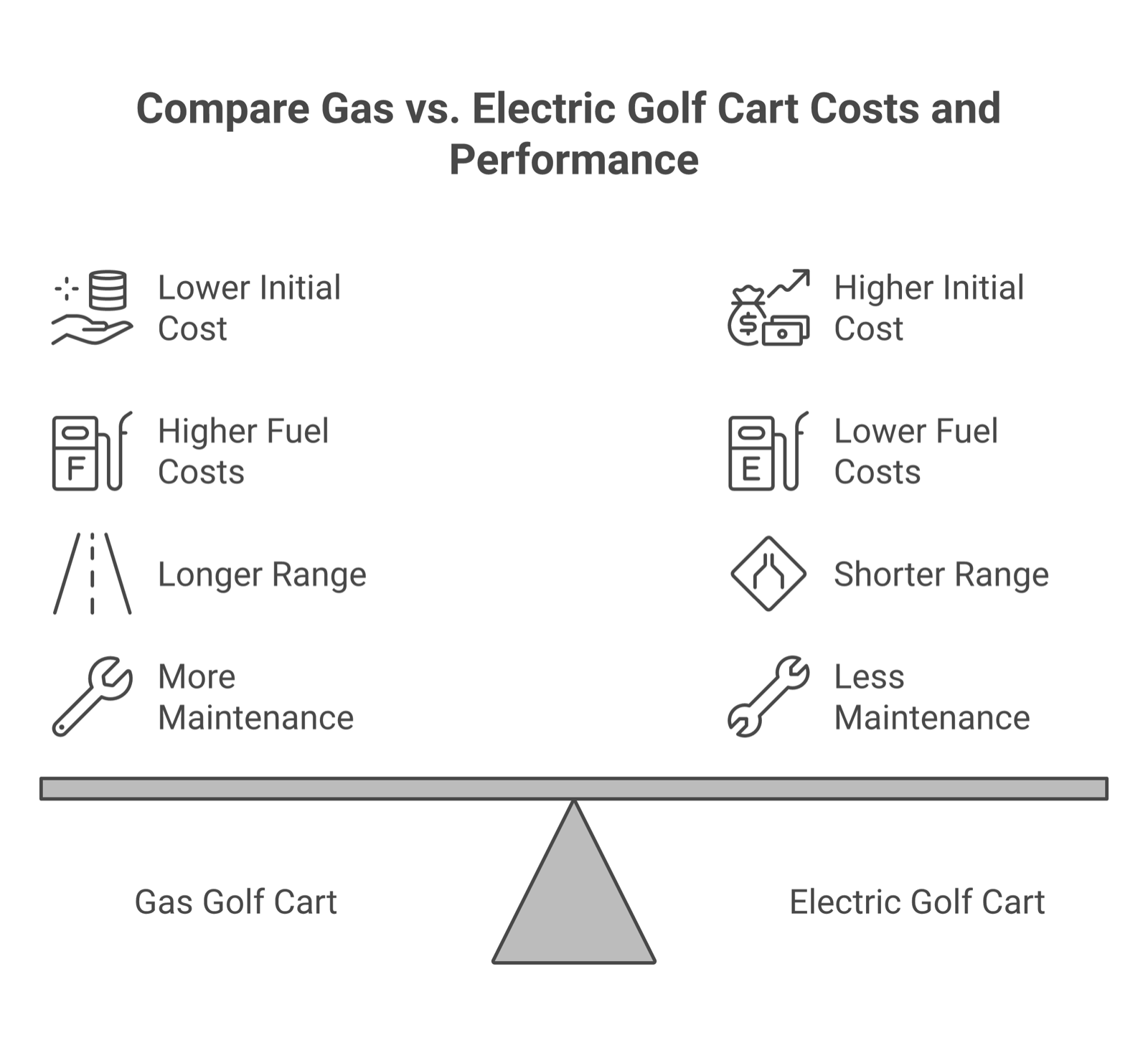
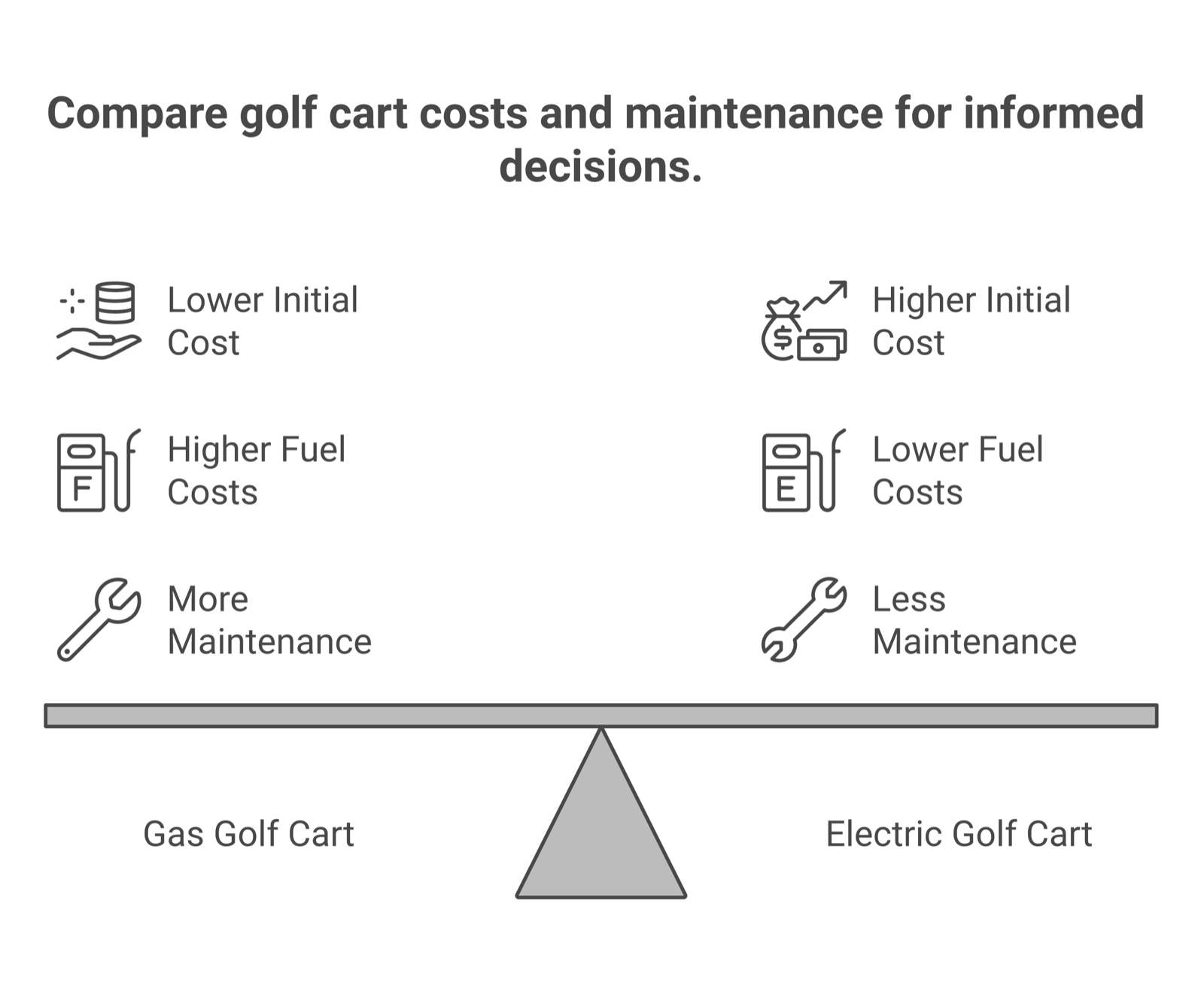
Gas vs Electric Golf Cart: Quick Comparison Table
| Factor | Gas Golf Cart | Electric Golf Cart |
|---|---|---|
| Purchase Price | $9,899 to $16,199 (Yamaha Drive2 PTV EFI to Club Car Onward 6 gas, MSRP) | $10,549 to $19,899 (Drive2 PTV PowerTech AC to Onward 6 Lithium Ion XR, MSRP) |
| Fuel/Energy Cost | About $0.10/mile (Yamaha's 45 mpg estimate at $4.465/gal) | About $0.05/mile (EA4X4 pack and range at 18.31 cents/kWh) |
| Range | About 260 miles per tank (Yamaha: 5.8 gal at 45 mpg) | Up to 40 to 50 miles per charge (EA lithium models) |
| Top Speed | Up to 19 mph (Yamaha, E-Z-GO gas models) | Up to 19 mph (Yamaha, E-Z-GO); 25 mph (EA 4- and 6-seat models) |
| Maintenance | Engine oil, spark plug, air filter, CVT belt, fuel system checks | Daily charging; tire, brake and wiring checks |
| Noise Level | Engine noise (Yamaha lists 60.5 dB for QuieTech EFI) | Near-silent |
| Emissions | CO, hydrocarbons, NOx | Zero tailpipe |
| Refuel/Recharge Time | A few minutes at the pump | 6 to 8 hours on a 120V outlet (EA4X4, EA6R+) |
| Lifespan | No maker-published figure; depends on engine upkeep | No maker-published cart figure; E-Z-GO ELiTE lithium battery warranty: 8 years |
Purchase Price: How Do They Compare?
Gas and electric golf carts fall into similar price ranges at the entry level. According to State Farm, basic models of either type start between $4,000 and $8,000, while mid-range options run $8,000 to $12,000. Premium and luxury carts can exceed $20,000.
EA Carts, the electric golf cart manufacturer headquartered in Carmel, Indiana, offers models across 60V and 72V configurations. Their lineup includes the EA Carts EA4F+ 60V, the EA Carts EA4R+ 60V, and the EA Carts EA4X4 72V, a true 72-volt, 200-amp four-wheel-drive golf cart. EA Carts has worked with the Indianapolis Colts and is the official golf cart partner of TaylorMade Golf.
For a brand-specific example, E-Z-GO's 2027 RXV 2 starts at $9,274 and is sold in both gas and electric versions. Yamaha lists the Drive2 PTV at $9,899 for the QuieTech EFI gas model and $10,549 for the PowerTech AC electric model, per each manufacturer's site on September 29, 2026.
EA Carts offers an all-electric lineup with lithium batteries included at every price point. The EA2GOLF 60V starts at $13,898, while the EA4R+ 60V four-seater starts at $14,498. A key difference: EA Carts includes the lithium battery pack in the base price. With competitors, lithium is often an upgrade that adds to the sticker price.
Operating Costs: Gas Adds Up Fast
This is where electric carts pull ahead. What a charge costs depends on the size of the battery and your local rate. At the U.S. average residential electricity price of 18.31 cents per kWh (EIA, July 2026), filling Club Car's standard 4 kWh lithium battery costs about $0.73, and its 7 kWh upgrade about $1.28, before charger losses. EA's EA4X4 pairs a 72V 200Ah pack (about 14.4 kWh) with a published range of 45 to 50 miles in 2WD, which works out to about $0.06 per mile.
Gas carts cost more per mile. The EIA put U.S. regular gasoline at $4.465 a gallon for the week of September 28, 2026, and Yamaha estimates 45 mpg for its Drive2 PTV QuieTech EFI, so fuel runs about $0.10 per mile. Over 5,000 miles a year, that is about $496 in gasoline against about $237 to $264 in electricity at the EA4X4 figures above, a saving of roughly $230 to $260 per year with the electric cart.
Insurance typically runs $100 to $300 per year according to State Farm, depending on the value of the cart and the coverage you choose.
Maintenance: Fewer Moving Parts, Fewer Problems
Gas golf carts run on internal combustion engines, and their service schedules show it. The E-Z-GO RXV EX1 EFI owner's manual calls for a first oil change at 25 hours, then fresh engine oil every 400 hours or 2 years, a new spark plug every 500 hours or 2 years, air filter and CVT belt inspections every 125 hours or 6 months, fuel system leak checks, and dealer valve checks at 1,000 hours or 4 years. No manufacturer publishes a dollar figure for this, so the cost depends on your dealer's rates and how many hours you drive.
Electric golf carts have far fewer moving parts. There is no engine oil, no spark plugs, no fuel system. The E-Z-GO RXV ELiTE owner's manual schedule covers daily charging and checks of tires, brakes and lights, monthly wiring and steering inspections, a wheel alignment check every 3 months, and a rear axle fluid change at 5 years. No maker publishes an annual cost, so plan for tires, brakes and dealer labor at local rates.
The one area where electric carts carry a higher long-term cost is battery replacement. State Farm lists lead-acid batteries at $250 to $1,600 with a 2 to 4 year life, AGM sets at $1,200 to $2,000 lasting 3 to 5 years, and lithium at $2,500 to $3,500. For how long lithium lasts, the maker's warranty is the published figure: E-Z-GO covers its ELiTE lithium batteries for 8 years, and EA Carts lists a lifetime battery replacement program on the EA4X4 and EA6R+ (up to $2,500, original purchaser, conditions apply). That is why buying an electric cart with lithium batteries included, like the EA4F+ lineup, saves you from a surprise battery bill down the road.
Range and Refueling
Gas carts win on raw range. Yamaha's Drive2 PTV QuieTech EFI carries 5.8 gallons and is rated at an estimated 45 mpg, which works out to about 260 miles per tank, and refueling takes a few minutes at the pump.
Electric range depends on the battery and the load. EA publishes up to 40 miles for the EA4F+, about 40 to 45 miles for the EA6R+, and 45 to 50 miles in 2WD (35 to 40 in 4WD) for the EA4X4, all on lithium, and lists 6 to 8 hours for a full recharge from a standard 120V outlet on the EA4X4 and EA6R+. For short daily trips around neighborhoods, golf courses, or gated communities, that leaves room to spare. You plug in at night and wake up to a full charge.
If you need to cover 50+ miles in a single outing or work on a large property without access to charging, gas may still make sense. For tips on getting the most from your battery, check out our FAQ page for common questions about electric cart range and charging.
Performance: Power, Speed, and Torque
E-Z-GO rates the gas engine in its RXV EFI at 11.5 horsepower. They deliver consistent power under load, which makes them popular for hauling heavy cargo or climbing steep hills repeatedly.
Electric motors carry lower ratings (E-Z-GO lists 4.4 hp continuous for the RXV ELiTE, and Yamaha lists 6.7 hp for the Drive2 PTV PowerTech AC), but the way electric motors deliver torque changes the equation. Electric motors produce peak torque at zero RPM, giving you instant acceleration off the line. Top speeds are close: Yamaha and E-Z-GO list up to 19 mph for both their gas and electric models, and EA lists 25 mph for the EA4F+, EA4R+, EA6R+ and EA4X4.
Higher-voltage electric systems close the power gap further. The EA4X4 72V is a true 72-volt, 200-amp 4WD electric golf cart, built for off-road terrain that would normally require a gas-powered vehicle. At $22,998, it handles hills, trails, and rough ground without burning a drop of fuel.
Noise and Neighborhood Use
This one is straightforward. Gas golf carts make engine noise, even the quieter designs: Yamaha lists 60.5 dB for its QuieTech EFI engine, which it sells as a reduced-noise model. The combustion engine produces a constant hum that neighbors notice, especially during early morning or evening rides. If you live under an HOA, read its cart rules before you buy, since associations can set their own.
Electric golf carts are nearly silent. You can drive through your neighborhood at 7 AM without waking anyone up. For community use, this is a major advantage. If you are shopping for a neighborhood golf cart, electric is the clear winner on noise alone.
Environmental Impact
Gas golf carts emit carbon monoxide, hydrocarbons, and nitrogen oxides. While a single cart does not produce much pollution, multiply that across a fleet of 100+ carts on a golf course or in a community, and emissions add up. Emissions rules for small engines come from federal and state regulators, so check what applies where you live.
Electric carts produce zero direct emissions. Charging still draws on the grid, so total emissions depend on how your local power is generated. For golf courses, resorts, and communities that market themselves as eco-friendly, an electric fleet takes tailpipe exhaust off the property.
Resale Value
Resale depends on age, condition and, for an electric cart, battery health, which is why battery type and age matter when you sell.
On a gas cart, the service record carries weight, since E-Z-GO's schedule runs by engine hours and a cart with no records leaves the buyer guessing. State Farm puts used golf carts at $2,000 to $10,000.
When a Gas Golf Cart Still Makes Sense
Gas is not dead. There are specific situations where a gas-powered cart is the better tool:
- Extended range needs: If you regularly drive 50+ miles per outing on a ranch, farm, or large commercial property without access to charging stations
- Remote locations: If you store the cart in an area without reliable electrical access
- Heavy commercial use: If you need to run a cart continuously for 10+ hours per day with no downtime for charging
- Long-term storage: Gas carts handle sitting unused for weeks or months better than lead-acid electric carts (though lithium batteries hold charge well during storage)
For most personal, neighborhood, and recreational use, these situations are the exception rather than the rule.
Why Many Buyers Choose Electric in 2026
E-Z-GO, Yamaha and Club Car all sell electric versions of their personal carts, and EA Carts builds only electric. According to Progressive Insurance, electric carts "can be notably less costly" than gas carts, and are cheaper "by virtually every measure." The advantages stack up:
- Purchase prices close to gas at comparable trim levels
- Lower fuel and energy costs
- Shorter service schedules (no oil, spark plugs or fuel system)
- Quieter operation for community and neighborhood use
- Zero tailpipe emissions
- Full torque from a standstill and comparable top speeds
- No engine hours to weigh at resale
The main objection, range anxiety, has been largely addressed by lithium battery technology. EA's 60V EA4F+ publishes up to 40 miles per charge, and its 72V EA6R+ and EA4X4 publish about 40 to 45 and 45 to 50 miles (2WD).
EA Carts: Built Electric From the Ground Up
EA Carts does not sell gas models. The entire lineup is electric, built around lithium battery systems from day one. That means every cart is engineered specifically for electric performance, not retrofitted from a gas platform.
Here is how the EA Carts lineup breaks down:
| Model | Voltage | Seats | Price | Best For |
|---|---|---|---|---|
| EA2GOLF | 60V | 2 | $13,898 | Golf course, solo riders |
| EA4R+ | 60V | 4 | $14,498 | Neighborhood cruising, upgraded performance |
| EA4R+ LIV Edition | 60V | 4 | $16,998 (sold out) | Premium features |
| EA4F+ | 60V | 4 | $16,298 | Premium forward-facing |
| EA4X4 | 72V | 4 | $22,998 | Off-road, trails, hills |
| EA6R+ | 72V | 6 | $15,998 | Families, group transport |
Every model includes the lithium battery in the base price. There is no upsell for battery upgrades. Lithium costs extra at E-Z-GO and Club Car: E-Z-GO's RXV 4 starts at $10,349 for the 48V AC Valor S and $11,949 for the ELiTE lithium Freedom, and Club Car's Onward 6 starts at $16,199 with flooded lead acid and $19,899 with Lithium Ion XR, per each manufacturer's site on September 29, 2026.
Ready to price one? Start with the EA4R+ 60V or, for six riders, the EA6R+ 72V.
EA Carts are available through the EA Carts website and have been delivered to customers in 43 states, with delivery quoted for each order. The brand has worked with the Indianapolis Colts and is the official golf cart partner of TaylorMade Golf.
If you want to compare models side by side, check the full cart lineup. For financing options, visit the financing page.
Total Cost of Ownership: 5-Year Breakdown
Here is a 5-year ownership scenario built only from published figures. It compares the same cart in two versions, Yamaha's Drive2 PTV with the QuieTech EFI gas engine and with PowerTech Li lithium, assuming 3,000 miles driven per year (about 8 miles per day).
| Cost Category | Gas Cart (5 Years) | Electric Cart with Lithium (5 Years) |
|---|---|---|
| Purchase Price | $9,899 (Drive2 PTV QuieTech EFI, Yamaha MSRP) | $14,020 (Drive2 PTV PowerTech Li, Yamaha MSRP) |
| Fuel/Electricity | About $1,488 (15,000 miles at 45 mpg and $4.465/gal) | Yamaha publishes no energy figure. At the energy use EA publishes for the EA4X4, about $712 to $791 |
| Maintenance | Oil every 400 hrs or 2 yrs, spark plug every 500 hrs or 2 yrs, air filter and belt checks (E-Z-GO RXV EFI schedule); no published dollar cost | No oil, plug or fuel service; tire, brake, wiring and alignment checks (E-Z-GO RXV ELiTE schedule); no published dollar cost |
| Battery Replacement | N/A | Not listed on Yamaha's model page; for comparison, E-Z-GO warranties ELiTE lithium for 8 years |
| Total 5-Year Cost | About $11,387 (purchase and fuel; maintenance not priced) | About $14,732 to $14,811 (purchase, plus electricity at EA4X4 rates; maintenance not priced) |
The lithium Drive2 costs $4,121 more than the gas version at Yamaha's MSRP. Over the 5 years the gas cart uses about $1,488 in fuel, against roughly $712 to $791 in electricity at the energy use EA publishes for the EA4X4, so running costs recover about $700 to $780 of that gap. The electric cart's shorter service schedule narrows it further, by an amount that depends on your dealer's rates. EA Carts prices every model with the lithium battery included, so there is no separate lithium step to add. Inputs: Yamaha MSRPs and Yamaha's 45 mpg estimate on September 29, 2026, the EIA U.S. regular gasoline average of $4.465 for the week of September 28, 2026, the EIA residential electricity average of 18.31 cents per kWh for July 2026, and service intervals from E-Z-GO's RXV owner's manuals, used because Yamaha's manuals are not posted as open pages.
Frequently Asked Questions
Are electric golf carts faster than gas?
It depends on the model. Yamaha and E-Z-GO list up to 19 mph for both their gas and electric carts, while EA Carts lists 25 mph for the EA4F+, EA4R+, EA6R+ and EA4X4. Electric motors produce peak torque from a standstill, so they tend to feel quicker off the line.
How long do electric golf cart batteries last?
State Farm puts lead-acid battery life at 2 to 4 years and AGM at 3 to 5 years. For lithium, check the maker's warranty: E-Z-GO covers its ELiTE lithium batteries for 8 years. Battery lifespan depends on charging habits, storage conditions, and usage frequency.
Can I convert a gas golf cart to electric?
Yes, gas-to-electric conversion kits exist. Kit prices vary by supplier and battery choice, and installation labor is extra. However, a purpose-built electric cart will outperform a converted gas cart in almost every category because the frame, suspension, and electronics are designed for electric power from the start.
Do electric golf carts work in cold weather?
Yes, with some care. E-Z-GO's ELiTE charger checks the pack temperature and shuts down if the pack is too hot or too cold, and its owner's manual says to fully charge the pack before storing the cart in a cold climate. Storing your cart in a garage or covered area during winter helps maintain battery performance.
Which is better for hilly terrain, gas or electric?
Gas carts have traditionally been preferred for hilly terrain because of their consistent horsepower under load. However, higher-voltage electric carts like the EA4X4 72V with true 4WD handle hills and off-road terrain, which EA lists as sand, mud, gravel, steep hills and rough trails.
How much does it cost to charge an electric golf cart?
At the U.S. average residential electricity price of 18.31 cents per kWh (EIA, July 2026), a full charge of Club Car's standard 4 kWh lithium battery costs about $0.73, and its 7 kWh upgrade about $1.28, before charger losses. At 3,000 miles a year, the EA4X4's published pack and range work out to about $12 to $13 a month.
Do gas golf carts require more insurance than electric?
State Farm puts golf cart insurance at $100 to $300 per year, depending on the value of the cart and the coverage you choose. Ask your insurer whether it prices gas and electric carts differently.
What is the lifespan of a golf cart?
No manufacturer we checked publishes a lifespan in years, so it comes down to upkeep. Gas carts follow an engine service schedule that E-Z-GO runs out to valve checks at 1,000 hours, while electric carts eventually need a new battery pack: State Farm puts lead-acid life at 2 to 4 years, and E-Z-GO warranties its ELiTE lithium for 8 years.
Once you decide between gas and electric, check out our best golf cart brands for 2026.
For a brand comparison, see EA Carts vs Club Car: price, features, and warranty compared. For a 72V electric 6-seater built for family runs and resort fleets, see the 6-passenger electric golf cart.
Decided on electric? Compare the EA Carts lineup, or talk it through with our team.